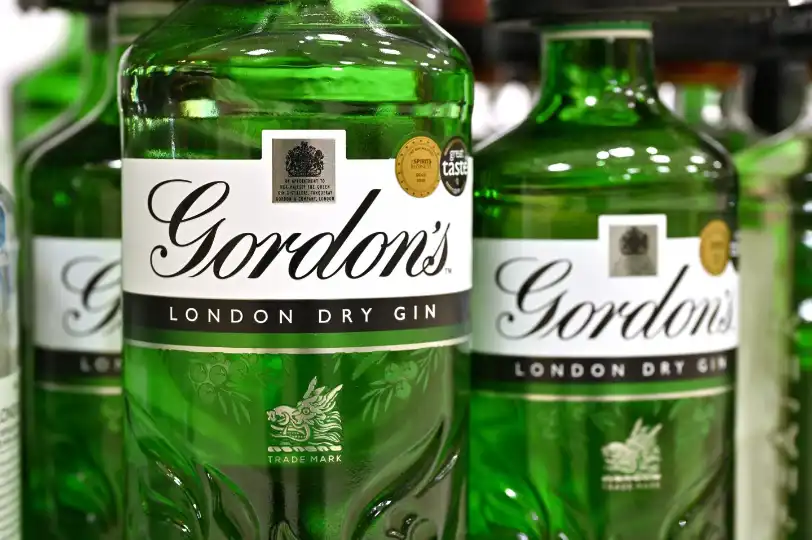
Diageo plans $500 million of cost cuts as U.S. tariffs kick in
Diageo Plc will cut costs by $500 million over three years as the maker of Johnnie Walker whisky grapples with US trade tariffs.President Donald Trump’s trade tariffs will cost $150 million annually at current levels, half of which it can mitigate, Diageo said in a statement Monday. The British distiller reiterated its guidance for the full year and expects sales growth to improve in the second half. The company’s shares rose as much as 2.4% in early trading in London. They had fallen just over 15% so far in 2025 through Friday’s close. Like rivals, Diageo has been hit by a slowdown in the US, its biggest market, and more recently higher trade friction that threatens to further dent consumer confidence. That led the company to scrap its long-held medium-term sales target in February. Organic net sales rose 5.9% in the third quarter, beating analyst estimates, as wholesalers in North America stocked up ahead of anticipated tariff announcements. Strong performance of Don Julio lifted tequila sales. Given that growth was driven by orders being pulled forward ahead of the tariff announcements, Diageo expects a weaker final quarter — though its second half performance overall will be an improvement on the first.Diageo didn’t give details on where it will cut costs. Rival Moët Hennessy said this month it would reduce its workforce due to shrinking demand as well as a tariff stand off between the European Union and China over Cognac.Citi analyst Simon Hales said Diageo’s cost-saving program should be well-received by investors, and with the absence of new negatives, there was “increasing confidence that Diageo is in control of what it can control.”Diageo said the Asia Pacific region continued to weigh on sales. It also expects a slight decline in organic operating profit in the second half of its fiscal year compared to last year, which includes the impact of the tariffs.“Tariff uncertainty represents a distraction, however Diageo is in recovery mode,” Jefferies analyst Edward Mundy said in a note.Join us at the Fortune Workplace Innovation Summit

Swiss watch exports to the U.S. soar nearly 150%, even as Trump’s higher tariffs are delayed
Swiss watch exports to the United States soared last month as US President Donald Trump called time out on tariffs, industry figures showed on Tuesday.Recommended VideoUS-bound shipments soared by 149.2 percent in April compared to the same month a year ago, according to the Federation of the Swiss Watch industry.Trump imposed a 10 percent tariff on imports from around the world in early April but hit dozens of countries with steeper duties, with Swiss goods facing a 31 percent levy.The US president, however, paused the higher tariffs until July to give time for negotiations.The surge in Swiss watch exports to the United States was “mainly the result of early shipments” as higher US tariffs loom, the federation said.“The sharp rise in exports is therefore more a reflection of a one-off response to an uncertain commercial situation than a genuine sign of a structural strengthening of demand,” it added.Global Swiss watch exports rose by 18.2 percent in April to 2.5 billion Swiss francs ($3 billion).Without the exceptional US shipments, overall exports would have fallen by 6.4 percent due to a slump in China and Hong Kong, the federation said.The United States is by far the main market for the Swiss watch industry, whose timepieces must be made domestically to earn the “made in Switzerland” label.Swiss President Karin Keller-Sutter held trade talks with US Treasury Secretary Scott Bessent in Geneva earlier this month.Join us at the Fortune Workplace Innovation SummitMay 19–20, 2026, in Atlanta. The next era of workplace innovation is here—and the old playbook is being rewritten. At this exclusive, high-energy event, the world’s most innovative leaders will convene to explore how AI, humanity, and strategy converge to redefine, again, the future of work. Register now.
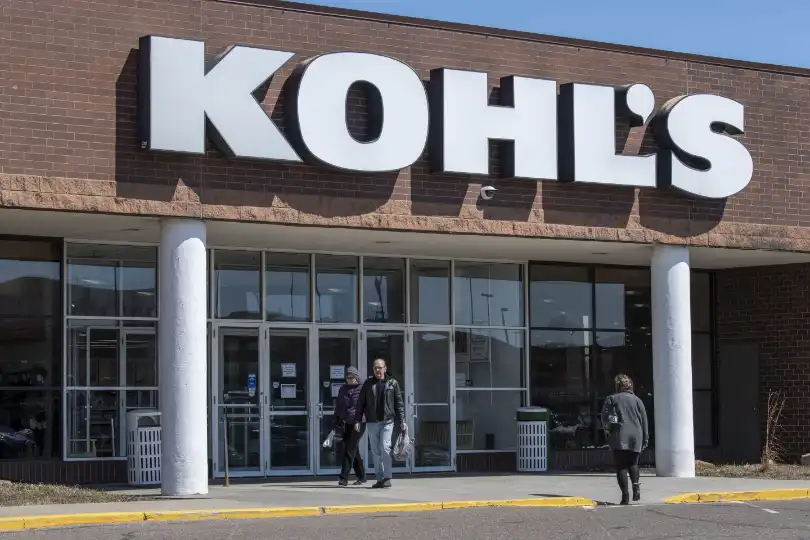
Kohl’s shocks investors reporting a not-too-bad quarter even after it fired its CEO just 100 days into the job
Kohl’shad its first earnings report since firing CEO Ashley Buchanan, and the results weren’t as bad as expected. While net sales were down and there were still losses per share, it wasn’t quite as severe as Wall Street had anticipated. The retailer also has a three-pronged approach to make a comeback.Kohl’s has had a rough year—but it might be showing signs of a turnaround. Recommended VideoThe retailer on Thursday reported Q1 2025 results that weren’t as bad as investors were expecting at a loss of 13 cents per share; Wall Street’s expectations were a loss of 25 cents per share. Still, net sales fell 4.1% from the year prior to $3.05 billion—but that was also better than analysts’ expectations of $3.02 billion. Comparable-store sales dropped 3.9%, according to the company’s earnings report.Kohl’s shares were trading up more than 3% Thursday morning, but its stock is still down more than 40% year-to-date.This is the first earnings report for Kohl’s since it fired CEO Ashley Buchanan earlier this month for violating company policies by directing the company to engage in vendor transactions that involved “undisclosed conflicts of interest” following an investigation conducted by outside counsel. It was later reported byThe Wall Street Journalthe deal involved a woman with whom Buchanan had a romantic relationship. Michael Bender is serving as interim CEO while Kohl’s finds a permanent replacement. He’s been on the board of Kohl’s since 2019 and previously served as president and CEO of optical retailer Eyemart Express. “I do want to recognize that there has been a lot of change for Kohl’s this past year, especially the last few weeks,” Bender said during the company’s Q1 2025 earnings call on Thursday. “While change can be difficult, it also represents an opportunity to reassess and commit to a path forward.”During the past year, Kohl’s has also downsized, closing about two dozen stores in 15 states and has also made corporate layoffs. On top of that—and losing a new CEO after just 100 days at his post—Kohl’s is still making up for mistakes from previous executives. Tom Kingsbury, who served as CEO before Buchanan, had opted for Kohl’s to carry less inventory, which ended up impacting the business. Kingsbury admitted to his downfalls like ditching petites and shrinking the company’s fine-jewelry business, calling his choices “shortsighted.”“We thought, ‘We can do more with a lot less,’ and that didn’t work out for us,” Kingsbury said during a December 2024 analysts call. He added it’s “up to us to fix it,” but Buchanan dropped the ball.Now, Kohl’s is recommitted to three areas of focus: curating a more balanced product assortment for customers, reestablishing the company as a leader in value and quality, and bringing back its fine-jewelry business, said Kohl’s CFO Jill Timm during the earnings call.“The most notable area we are correcting is our jewelry business, which we displaced as we rolled up Sephora in our stores,” Timm said. “This was a category that was highly penetrated by our most loyal Kohl’s card customers.” The company rolled out 200 jewelry shops at its stores in the fall, Timm added. Meanwhile, Kohl’s is also focused on improving its women’s clothing assortment and investing more in its Sephora shops, which reported a 6% net sales increase last quarter.Another major focus for Kohl’s this year will be doubling down on value. Because tariffs have impacted consumer sentiment across the board, the company is trying to be mindful of meeting the customer where they are—especially since much of Kohl’s customer base are middle-income consumers.“There are kitchen-table conversations going on across America every day. People are trying to figure out how to make sense of the dollars that they have to spend, and they’re prioritizing where they want to put it,” Bender said during the earnings call. “What’s important is making sure that we are as close to being inside their heads and understanding what their needs are and meeting those needs.”To this end, Timm said Kohl’s is navigating tariffs by diversifying the countries they use for production. “Although tariffs remain a fluid and uncertain situation, the teams continue to work to reduce our exposure to high-tariff countries … [and] adjusting orders based on pricing elasticity analysis,” Timm said. But while Kohl’s makes its best efforts, executives still admitted it’s a time of massive transition for the retailer. “We’re in the middle of a transformation, and in the early days—honestly—of it, and so it’s going to take some time for us to get back to that,” Bender said. “But the bottom line is that we’re trying to align the business to meet the needs of our customers.”Join us at the Fortune Workplace Innovation SummitMay 19–20, 2026, in Atlanta. The next era of workplace innovation is here—and the old playbook is being rewritten. At this exclusive, high-energy event, the world’s most innovative leaders will convene to explore how AI, humanity, and strategy converge to redefine, again, the future of work. Register now.
T.J. Maxx and Marshalls can ‘insulate’ themselves from tariffs because their business model is scooping up other retailers’ unsold inventory
T.J. Maxx and Marshalls parent company TJX has an advantageover its discount retail rivals, analysts said. TJX is an off-price retailer that sources much of its inventory from other retailers’ unsold products, meaning it doesn’t have to pay tariffs on the bulk of its goods. Moreover, consumers continue to pull back on discretionary goods from other retailers.Off-price retailers like T.J. Maxx are staying strong amid tariff concerns and economic uncertainty thanks in part to their ability to nab inventory from other retailers’ unsold products—after the initial buyer already paid import taxes on them.TJX, the parent company of T.J. Maxx, HomeGoods, and Marshalls, reported better-than-expected first-quarter earnings Wednesday, posting $13.11 billion in net sales for the quarter, compared to the estimated $13.01 billion, according to data compiled by LSEG. TJX’s share price was down about 3% as of Wednesday afternoon after CEO Ernie Herrman warned the company was “not immune to tariff pressure.”“The availability of merchandise we are seeing is outstanding, and we are in a great position to take advantage of the plentiful opportunities that the marketplace is offering,” Herrman said in a call with investors on Wednesday. “We are confident in our ability to navigate the current tariff and macro environment in the short term.”Off-price retailers are able to keep prices low by keeping an inventory of unsold items from other retailers, as well as brokering deals directly with manufacturers for brand name products in bulk. While logistics experts and economists warned of empty shelves as a result of tariffs causing companies to cut back on imports, Herrman shrugged off inventory concerns. The company reported a 7% increase in inventory per store.“This is a typical remark, but is important at a time when investors are worried about empty shelves,” Bank of America analyst Lorraine Hutchinson said in a note to investors on Wednesday. ‘Insulated’ from economic uncertaintyBank of America predicted earlier this month that off-price retailers would be able to use the strategy of sourcing unwanted inventory from other retailers to “insulate” themselves from tariffs. “The theory is that inventory would have already been [subject to] the tariffs [absorbed] by the original purchaser,” Brian Mulberry, client portfolio manager at Zacks Investment Management, toldFortune. “Therefore, the discount retailers don’t pass on this, or they don’t experience the same level of tariffs.”TJX sources about 60% of its products from other retailers, and about 40% from deals with manufacturers, Mulberry said. While the 40% of inventory bought directly from manufacturers are subject to tariffs, those products, often brand-name goods, have high appeal to consumers who may be otherwise skimping on discretionary purchases to save money.“If there is some type of pressure on the U.S. consumer that makes them a little bit more cost-conscious, the discounts that they’re getting at TJX is speaking to the wallet, if you will, of the consumer,” Mulberry said.HomeGoods advantageHerrman said he was confident that stores, particularly HomeGoods, will continue to be well stocked even as tariffs on China hover at 30% because TJX relies on about 21,000 vendors across 100 countries.“Our merchants deal with negotiating with the vendor, who’s in negotiations, really, with their factories in China,” he said. “I think the availability will be fine. There’s so many vendors that we deal with…I don’t really get concerned about empty shelves.”TJX’s well-stocked shelves and discount prices have given it a leg up over other discount retailers, Mulberry said. Target, which continues to post dismal earnings, has struggled to move inventory since the pandemic. While not always known as a discount store, it has had to slash prices on many of its goods in order to move them. Still, Target’s ticket size, or how much shoppers spent per transaction, decreased this quarter. Target did not immediately respond toFortune’s request for comment.Because TJX maintained its fiscal 2026 guidance of a 2% to 3% increase in comparable sales, UBS analyst Jay Sole posited the company would also have the edge on full-price rivals.“Our view is TJX will take major market share from Department Store peers over the next few years,” Sole said in a Wednesday note.
Mondelez is suing Aldi, alleging the supermarket chain ‘blatantly copies’ its packaging. The side-by-side photos are wild
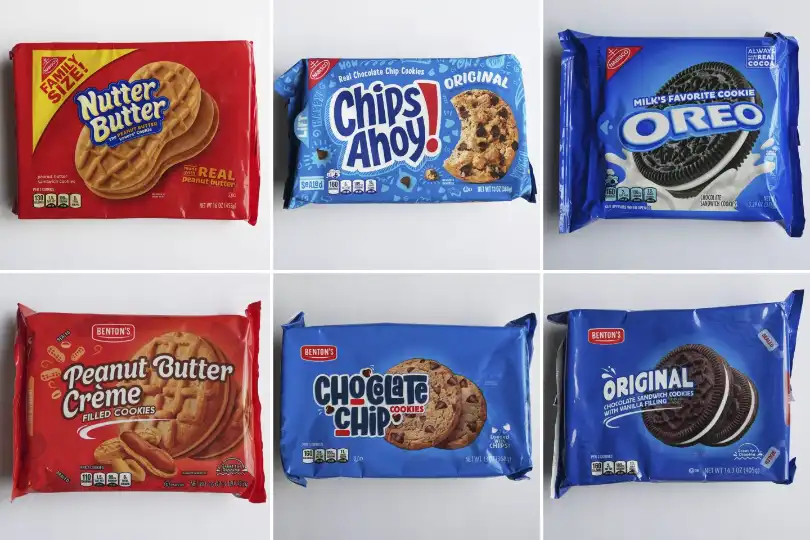
Snack food maker Mondelez International is suing the Aldi supermarket chain, alleging the packaging for Aldi’s store-brand cookies and crackers “blatantly copies” Mondelez products like Chips Ahoy, Wheat Thins and Oreos.In a federal lawsuit filed Tuesday in Illinois, Chicago-based Mondelez said Aldi’s packaging was “likely to deceive and confuse customers” and threatened to irreparably harm Mondelez and its brands. The company is seeking monetary damages and a court order that would stop Aldi from selling products that infringe on its trademarks.A message seeking comment was left Thursday with Aldi.In the lawsuit, Mondelez displayed side-by-side photos of multiple products. Aldi’s Thin Wheat crackers, for example, come in a gold box very similar to Mondelez’s Wheat Thins. Aldi’s chocolate sandwich cookies and Oreos both have blue packaging. The supermarket’s Golden Round crackers and Mondelez’s Ritz crackers are packaged in red boxes.Nam Y. Huh—AP PhotoAldi, a German discount chain with U.S. headquarters in Batavia, Illinois, keeps prices low by primarily selling products under its own labels.The chain has faced lawsuits over its packaging before. Last year, an Australian court found that Aldi infringed on the copyright of Baby Bellies snack puffs for young children. In that case, Aldi’s packaging featured a cartoon owl and similar colors to the name-brand packaging.Earlier this year, a U.K. appeals court ruled in favor of Thatchers, a cider company, which sued Aldi over design similarities in the packaging of its lemon cider.Mondelez said in its lawsuit that the company had contacted Aldi on numerous occasions about “confusingly similar packaging.” Mondelez said Aldi discontinued or changed the packaging on some items but continued to sell others.The lawsuit also alleges that Aldi infringed on Mondalez’s trade dress rights for the packaging of Nutter Butter and Nilla Wafers cookies, and its Premium cracker brand.Join us at the Fortune Workplace Innovation SummitMay 19–20, 2026, in Atlanta. The next era of workplace innovation is here—and the old playbook is being rewritten. At this exclusive, high-energy event, the world’s most innovative leaders will convene to explore how AI, humanity, and strategy converge to redefine, again, the future of work. Register now.
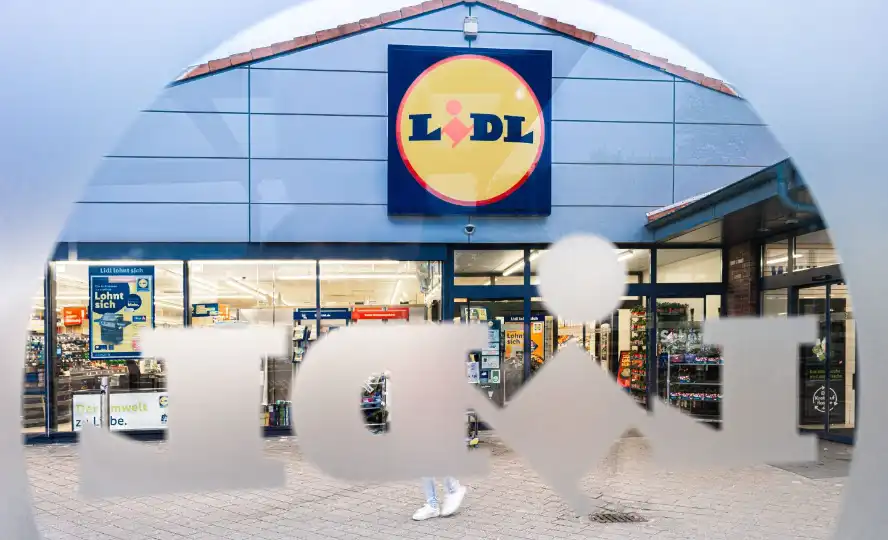
Lidl goes upmarket with a focus on elite London postcodes as part of its aggressive $665 million U.K. expansion
While the stars ofMade In Chelseamight find the organic quinoa a bit more difficult to locate in their new local Lidl, a shopping trip there will surely prove much more cost-effective than nipping into Whole Foods Market.Recommended VideoAnd that’s before they encounter the enticements of the eclectic discoveries within the Middle Aisle of Lidl.The news that they may be rubbing shoulders came after the German discount grocer Lidl announced ambitions to open 40 new supermarkets in the UK this year as it prepares to spend around $665 million on expanding its U.K. store estate, including a wishlist of decidedly upscale London locations such as Kensington, Notting Hill, Covent Garden, and Soho.Those pricey postcodes are just a few of over 250 potential new site locations that it has identified across the UK capital, with a special focus on affluent central neighborhoods, plus suburban locations, high street sites, retail parks and shopping centers.Pretty much everywhere, in other words.Lidl currently has more than 120 stores within the M25 freeway that orbits London and said it has requirements for at least 100 more, while it has nearly 1,000 stores across the UK.Construction of a new regional hub in Leeds is also set to start this year.“As we enter our fourth decade in Great Britain and hurtle towards a thousand stores, there are still so many parts of the country crying out for convenient access to a Lidl store,” Lidl GB chief real estate officer Richard Taylor said. “This level of investment is a clear sign of our ambition.”Indeed, those confident expansion plans follow hot on the heels of Lidl and its German rival Aldi both gaining market share over the Easter bank holiday weekend, despite it more typically being a time of year when the larger supermarket chains make the biggest gains.Lidl saw its market share rise by 0.4 percentage points to 7.7%, according to data by NIQ, while Aldi – which has slightly more stores than its rivals – market share was up 0.2 percentage points to 10.5% over the 12 weeks to April 19, having reached an all-time high at the start of April when it hit 11%. Lidl, which has operated in the U.K. for 30 years, posted a 16.9% rise in annual revenue to over $14.5 billion in its most recent accounts, with pre-tax earnings jumping to just over $293 million.Its ambitious British plans are mirrored in the U.S., where Lidl’s North American operation, after a stop/start history in the U.S., is currently growing its footprint in New York City, with plans to open a store in Brooklyn on May 23 after previously opening at the nearby Gateway Center mall, plus another in the pipeline within the mixed-use Brooklyn’s Crown Heights complex.Lidl U.S. currently has more than 170 stores across nine East Coast states and Washington, D.C.Meantime Aldi, which has a significantly bigger presence in North America than its rival, has continued to push ahead with its US expansion and has recently opened its first two stores in the Las Vegas area, with more to follow, as it aims to open more than 220 stores this year. Aldi’s longer-term goal is to open 800 new locations by the end of 2028.Join us at the Fortune Workplace Innovation SummitMay 19–20, 2026, in Atlanta. The next era of workplace innovation is here—and the old playbook is being rewritten. At this exclusive, high-energy event, the world’s most innovative leaders will convene to explore how AI, humanity, and strategy converge to redefine, again, the future of work. Register now.

Dior’s revival rests on its historic appointment of Jonathan Anderson as creative director
Christian Dior, one of the main businesses within French conglomerate LVMH, will have a new creative chief overseeing the entire brand—Jonathan Anderson. Recommended VideoOriginally from Northern Ireland, Anderson was previously the long-time designer at another LVMH-owned brand, Loewe, credited with turning it into a buzzy, trending label. Now, he’ll be only the second person after Christian Dior to lead the fashion house’s men’s, women’s, and couture divisions.The announcement followed the departure of Dior’s first female designer, Maria Grazia Chiuri, last week after nine years. Anderson will now design a range of collections, the first of which will be presented in late June, marking the start of a new journey for the well-known fashion label.“New creative energy is a step in the right direction,” Luca Solca, a luxury analyst at Bernstein SG, wrote in a note following Chiuri’s departure. Dior accounts for nearly 20% of LVMH’s fashion and leather goods segment—the most lucrative part of its business. It’s overseen by CEO Bernard Arnault’s daughter, Delphine. It’s also been crimped by the luxury slowdown after successive price increases in recent years, as shoppers favor more reasonably priced brands. “At 40, Jonathan Anderson has exceptional qualities combining creativity and savoir-faire. He is attentive to commercial demands and has the talent to respond to them with his characteristic daring and inventiveness,” Delphine Arnault toldFortune.The Anderson effectThe Irish-born Anderson has accomplished much on his way to securing the top job at Dior. When he joined Loewe, the Spanish brand LVMH bought in 1996, he was just 29 years old and tasked with turning around the brand. He also ran his brand JW Anderson on the side.His collections balanced traditional and modern designs, featuring footwear with smashed eggs on their heels and an ad campaign with the 88-year-old Maggie Smith instead of opting for a younger model. Loewe has also had viral moments, such as when Rihanna wore its red jumpsuits at the 2023 Super Bowl. The brand also gained from the recent “quiet luxury” trend, in which people opted for more understated luxury brands over recognizable ones. Loewe’s sales went from approximately €230 million in 2014 to between €1.5 billion and €2 billion in 2024, per Morgan Stanley and Bernstein SG estimates, respectively.“Anderson has a strong track record from his time at Loewe – one of the top performing brands at LVMH’s fashion & leather in the past few years,” Jelena Sokolova, an analyst at Morningstar, said in a note Monday. She added that his role as the unified creative director could further help strengthen Dior as it’s proved a “weaker link” in LVMH’s portfolio.“This should help Dior create a more consistent brand representation and improve [its] stance amongst peers,” Sokolova said. It won’t be an easy job for Anderson—the reason Dior typically appoints different creative directors for men’s and women’s fashion is because of how taxing it could be to develop 10 different collections. And at a brand with the status of Dior in the fashion circle, the stakes are even higher. But Anderson has proved himself over the years, leading multiple creative endeavors with great success.“I have followed his career with great interest since he joined the LVMH group over ten years ago. I am convinced that he will bring a creative and modern vision to our House, inspired by the fabulous story of Monsieur Dior and the codes he created,” Arnault said in a statement. A rocky period for the luxury sector has prompted a slew of creative leadership changes in recent months, including at Kering-owned Gucci and privately-owned bag maker Chanel. While the shuffling around is done in the hopes that the new creative era would be characterized by more growth, there’s virtually no guarantee.It’ll take new designs, a recovery in high-end spending, and generating more brand heat for brands to revive themselves. Update, June 2, 2025: This article has been updated with quotes from Delphine Arnault.Join us at the Fortune Workplace Innovation SummitMay 19–20, 2026, in Atlanta. The next era of workplace innovation is here—and the old playbook is being rewritten. At this exclusive, high-energy event, the world’s most innovative leaders will convene to explore how AI, humanity, and strategy converge to redefine, again, the future of work. Register now.
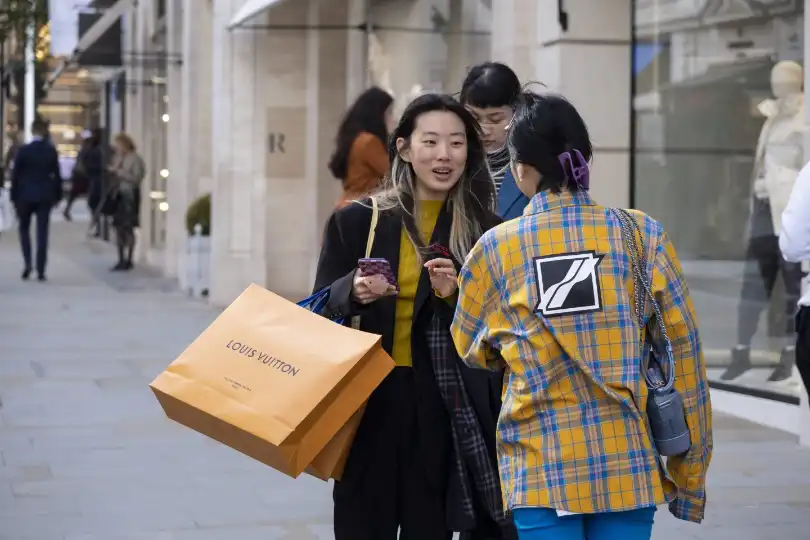
LVMH’s U.S. CEO is glad ‘pretty annoying’ quiet luxury term has died
LVMH U.S. CEO Anish Melwani expressed relief over the decline of the “quiet luxury” trend,arguing that while understated elegance has long existed within LVMH brands, the trend limited consumer expression and choice in the luxury space. As the industry shifts, European luxury brands now face a new challenge in the form of potential U.S. tariffs under President Trump’s proposed plan, which may lead to price hikes that consumers are expected to absorb.The CEO heading up operations for designer empire LVMH in the U.S. said he’s glad to see the back of the “quiet luxury” trend.Recommended VideoDriven by social media engagement, the quiet luxury craze referred to a lifestyle and aesthetic focused on high-quality, timeless pieces largely free of branding.Anish Melwani, the chairman and CEO of LVMH U.S., said understated brands have always existed within the LVMH portfolio, and even labels associated with status dressing go through cycles of dropping their monogram.Melwani argued that the beauty of the luxury sector is that it offers an aspirational goal to any consumer, and that the quiet luxury trend threatened to hamstring choice.“I’ve always argued that luxury is connected to the underlying human emotion of accomplishment,” Melwani told the Milken Institute’s global conference on Tuesday.Speaking on the panel moderated byFortune‘s Diane Brady, Melwani continued: “When you really get it right you provide a product that a consumer, when they purchase it, they feel accomplished. That can manifest in different ways, but it’s fundamentally a feeling of accomplishment and it’s an inspiration.”Customers of LVMH have many brands to choose from for that sense of accomplishment.The stable of brands under the Paris-based LVMH umbrella includes maisons such as Louis Vuitton, Dior, Fendi, Loewe, and Givenchy, as well as jewelry and watch designers such as Tiffany & Co, Bulgari, and Tag Heuer.The group is headed by tycoon Bernard Arnault, who is worth more than $147 billion, according toForbes.“One of the geniuses of Mr. Arnault is recognizing that consumers at this level are not monolithic in what makes them feel accomplished,” Melwani added. “Hopefully we’re past the term ‘quiet luxury’—that was getting pretty annoying—especially because it’s not new.“If you ask Loro Piana, they would say, ‘We’ve been doing quiet luxury for 50 years.’ If you actually look at Fendi, Fendi’s had its periods where it’s been heavily logoed and monogrammed, and there’s been periods where less than 2% of the product line had any logo on it at all.”The next headache for fashion: Trump tariffsThe idea of quiet luxury began circulating most notably online, courtesy of the TV show Succession.In one scene, a character attached to a wealthy family is appalled by a guest’s “ludicrously capacious bag.”The bag in question features a well-known print from a designer brand, and is large enough to fit items such as a lunch box or “subway shoes” inside—neither of which would be needed by an extremely well-off individual.The scene exemplifies how an item proudly worn by one individual may be viewed as gauche by another.“It’s impossible for any one brand to truly give that feeling of accomplishment to everyone,” chimed in Melwani.“By having a portfolio, and more importantly having maisons be independent and autonomous, allows each maison to use its own heritage to create that feeling of desirability, to create that feeling of accomplishment in the audience they’re speaking to and allow people to find what is it that’s going to make them have that feeling.”But having successfully navigated consumer trends like quiet luxury and subdued shoppers in major geographies like China, the luxury sector, most notably high fashion out of Europe, faces a new challenge.This is, of course, President Trump’s tariff plan which includes a 20% hike on the EU following the conclusion of his 90-day pause.Some 70% of the global luxury goods market is based out of Europe, and while this presents an outsize problem for the sector as a whole, it also gives the companies greater power.“We would expect most European luxury companies to pass on the tariffs in the form of price increases to end consumers, who tend to be less sensitive to pricing and accustomed to regional price differentials,” UBS equity analyst Zuzanna Pusz wrote in a note earlier this year.Join us at the Fortune Workplace Innovation SummitMay 19–20, 2026, in Atlanta. The next era of workplace innovation is here—and the old playbook is being rewritten. At this exclusive, high-energy event, the world’s most innovative leaders will convene to explore how AI, humanity, and strategy converge to redefine, again, the future of work. Register now.

Here’s what’s open (and closed) on Memorial Day 2025
Memorial Day, strictly speaking, is meant to honor American soldiers who have died in military service. But for many people, it’s the official start to summer—and to many businesses, it’s a chance for the last blowout sale before people temporarily de-emphasize shopping for outdoor pursuits.Recommended VideoSure, summer won’t officially start until next month, but as temperatures rise and community pools open, it’s an excuse to finally put away the winter clothes and re-embrace the outdoors. It’s also a chance for people to collectively catch their breath after sprinting through the first five months of the year—and 2025 has unquestionably been a sprint.Retailers, as they often do on holidays, will try to lure in shoppers with extra time. But not every store is open, however. And people often get confused over what (if any) government and private services are available. Here’s a look at who’s open and who’s closed on Memorial Day.Are banks open on Memorial Day 2025?They are not, since Memorial Day is a federal bank holiday. You can, however, do your banking at your financial institution’s app or at an ATM machine.Is the post office open on Memorial Day 2025?The U.S. Postal Service is closed for the same reason banks are: It’s a federal holiday. No mail delivery will take place. UPS and FedEx also observe the holiday, but UPS Express Critical and FedEx Custom Critical are still available. FedEx will suspend service as well, but select FedEx Office stores will be open, with modified hours.Is the stock market open on Memorial Day 2025?After the volatility the stock market has seen so far this year, maybe a day of rest is a good thing. The New York Stock Exchange, Nasdaq and bond markets are all closed.Which department stores are closed on Memorial Day 2025?While most retailers will be open, Costco locations nationwide will be closed. Some smaller businesses might opt to enjoy the holiday, as well.Which department stores are open on Memorial Day 2025?Bass Pro Shops– Open on Memorial DayBelk– Open on Memorial DayCabella’s– Open on Memorial DayCVS– Open on Memorial DayDillards– Open Memorial DayGuitar Center– Open Memorial DayHome Depot– Open on Memorial DayIkea– Open on Memorial DayKohl’s– Most store are open.Lowe’s– Open on Memorial DayMacy’s– Open Memorial DayMichael’s– Open Memorial DayOld Navy– Open on Memorial DayRite Aid– Open on Memorial DayTarget– Open Memorial DayT.J. Maxx– Closed SundayWalgreens– Open on Memorial DayWalmart– Supercenters remain open 24 hoursWhich grocery stores are open on Memorial Day 2025?Memorial Day is one of the biggest cookout days of the year. Grocers know that. So if you find yourself out of buns, burgers or chips, you should be able to restock without much trouble.As with any holiday, call to see if the location near you has reduced hours.Aldi– Open on Memorial DayBi-Lo– Open on Memorial DayFood Lion– Open on Memorial DayGiant Eagle– Open on Memorial DayHarris Teeter– Open on Memorial DayIngles– Open on Memorial DayKroger– Open on Memorial DayPublix– Open on Memorial Day.Safeway– Open on Memorial DayShopRite– Open on Memorial DayStop and Shop– Open on Memorial DayTrader Joe’s– Open on Memorial DayWegman’s– Open on Memorial DayWhole Foods– Open on Memorial DayWinn-Dixie– Open on Memorial DayJoin us at the Fortune Workplace Innovation SummitMay 19–20, 2026, in Atlanta. The next era of workplace innovation is here—and the old playbook is being rewritten. At this exclusive, high-energy event, the world’s most innovative leaders will convene to explore how AI, humanity, and strategy converge to redefine, again, the future of work. Register now.

Walmart and Amazon prices are going up despite Trump’s China tariff reduction
If there was any thought that the Trump administration’s 90-day pullback of China tariffs might keep retail prices stable, leaders of the country’s largest retailer dismissedthat notion on Thursday.“We will do our best to keep our prices as low as possible,” WalmartCEO Doug McMillon said in a statement alongside the retailer’s quarterly earnings. “But given the magnitude of the tariffs, even at the reduced levels announced this week, we aren’t able to absorb all the pressure given the reality of narrow retail margins.”Recommended Video“[E]ven at the reduced levels, the higher tariffs will result in higher prices,” McMillon added.Walmart Chief Financial Officer John Rainey echoed the same sentiment in an interview with CNBC, saying that customers will start noticing price increases later this month and into June.“We’re wired for everyday low prices, but the magnitude of these increases is more than any retailer can absorb,” he said. “It’s more than any supplier can absorb.”Walmart held off from providing second-quarter profit guidance amid continued tariff uncertainty. McMillon previously warned Trump against the negative impacts of high tariffs in a private meeting last month, according to news reports.The reality check comes less than a week after the Trump administration announced that the U.S. and China had reached a deal that would temporarily reduce U.S. tariffs on China-made goods from as high as 145% to 30% over the next 90 days, while the two countries tried to hammer out a permanent agreement. The announcement sent stocks soaring, and on the surface seemed like it might provide at least some relief to the plethora of U.S. brands and retailers, big and small, that rely on China’s manufacturing expertise to produce their merchandise.But Walmart leaders partially burst that bubble on Thursday. And for his part, Amazon CEO Andy Jassy told CNBC last month that he expected at least some of Amazon’s two million sellers would attempt to pass along costs from increased importing duties to Amazon shoppers.AsFortunereported exclusively at the time, Amazon penalized some when they initially tried to push through large price hikes, before backing off in some cases. But multiple top Amazon sellers toldFortunethis week that they would maintain at least some price increases on the online megastore since China tariffs are still significant and heavily cutting into their margins.Amazon spokesperson Jessica Martin said in a statement that the company has “not seen the average prices of products offered in our store change up or down appreciably outside of typical fluctuations across millions of items on Amazon” and maintained that Amazon continues to “meet or beat prices versus other retailers on the vast majority of items.”E-commerce software firm SmartScout shared data withFortunethis week showing that more than 4,000 of Amazon’s top-sellers were currently priced at an all-time high — or about 3% of a sample of more than 125,000 items that the firm evaluated.Update, May 16, 2025:This article has been updated with a comment from Amazon and with more context about SmartScout’s research.Are you a current or former Walmart or Amazon employee or seller with thoughts on this topic or a tip to share? Contact Jason Del Rey at jason.delrey@fortune.com, jasondelrey@protonmail.com, or through messaging apps Signal and WhatsApp at 917-655-4267. You can also contact him on LinkedIn or at @delrey on X, @jdelrey on Threads, and on Bluesky.Join us at the Fortune Workplace Innovation SummitMay 19–20, 2026, in Atlanta. The next era of workplace innovation is here—and the old playbook is being rewritten. At this exclusive, high-energy event, the world’s most innovative leaders will convene to explore how AI, humanity, and strategy converge to redefine, again, the future of work. Register now.
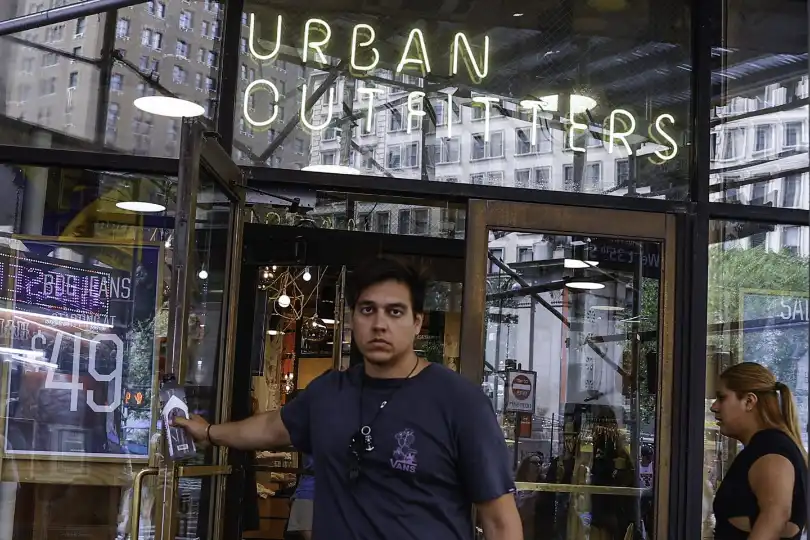
Tariffs are threatening the accuracy of fall fashion trends by forcing earlier clothing shipments amid supply-chain headaches, Urban Outfitters CEO says
The fashion industry had a unique concern about the impact of tariffs. Continued uncertainty has pushed Urban Outfitters to move up shipments of its fall product, putting it at an increased risk of miscalculating fall fashion trends. Apparel retailers must strike a balance in giving themselves time to predict new styles, while also shipping inventory early enough to sell it all to consumers, Northeastern University professor Shawn Bhimani toldFortune.President Donald Trump’s tariffs may mean that your new autumn sweaters may already be so last year.Recommended VideoThe U.S.’s steep levies on clothing production giants like China and India is forcing retailers like Urban Outfitters to make supply-chain changes that may result in stocking inventories that don’t fully align with seasonal fashion trends.Urban Outfitters chief financial officer Melanie Marein-Efron said the Philadelphia-based apparel retailer will likely have to pull forward shipments of its products for autumn as result of tariff concerns.“While our teams continue to focus on increasing inventory turns, the uncertainty around tariffs means we are likely to bring in fall product a bit earlier,” Marein-Efron told investors on Wednesday following its first-quarter earnings report.She added that because of tariffs, as well as to plan for future supply-chain disruptions, the retailer needed to plan to pull forward its fall inventory, which is less sensitive to changing fashion trends.In order to save on costs, the company will shift its shipping method from air to sea, which will add about 30 days to the products’ delivery time. While Urban Outfitters may secure its fall inventory, the earlier shipment dates means it won’t have as much time to predict what styles consumers will want once the leaves start to change colors and temperatures cool.“There is always a risk as you go out in time that the fashion might not be as accurate as we would like it to be,” Urban Outfitters CEO Richard Hayne told investors.As Urban Outfitters grapples with the ramifications of tariffs, so too do other retailers having to scramble to rearrange supply chains, as well as pull forward shipments of goods to dodge the impact of the levies. Logistics professionals warn whipsaw tariff policies are encouraging stockpiling behaviors, which may result in headaches down the line for retailers like shortages or inventory pile-ups.URBN—the parent company of Urban Outfitters, as well as Anthropologie, Free People, and Nuuly—reported strong first-quarter earnings, posting 11% sales growth in the first quarter and a 5% increase in same-stores sales. Its quarterly revenue of $1.33 billion exceeded the $1.29 billion analysts expected.Trouble for the fashion worldFor the apparel industry, widespread tariffs represent a threat to the delicate balance retailers have in predicting what people will want to buy, and procuring those items on a timeline that will allow them to sell most of that inventory, according to Shawn Bhimani, assistant professor of supply chain and information management at Northeastern University.“To mitigate the cost of tariffs, we are procuring inventory early or shipping it on a more economical ocean freight, and that means that we’re having to predict much earlier,” Bhimani toldFortune. “The further out someone tries to predict the future, the more incorrect the prediction will be. That’s where we get into trouble with the fashion industry.”Retailers are also having to contend with consumers who may slow down their spending once tariff-induced price hikes go into effect. Combined with plenty of products that may not resonate with consumers, stores may be saddled with inventory or be forced to sell it to third-party vendors at a massive discount.Retailers will weigh their options on how best to mitigate the impact of tariffs. Some may switch from ocean freight to the more expensive air freight to give themselves more time to assess consumer trends. Others may resort to delayed differentiation, shipping products to their facilities, but waiting on more seasonal-trends data to dye or alter pieces of clothing in bulk, for example, Bhimani said.More broadly, many companies will look for new suppliers, or have candid conversations with current suppliers about their changing needs. The results of these conversations may be changes in “incoterms,” or rules that distinguish the responsibilities of buyers and sellers. Rather than a supplier shipping a product to a port, for instance, it may instead ship goods to a factory. Ultimately, Bhimani said, these changes in terms become a broader conversation around who pays for tariffs: the supplier, or the retailer.The fashion industry is just one of many that has turned to expanding supply chains and stockpiling goods as a means of bracing for the impact of tariffs, the terms of which will likely continue to shift as they have since February. These near unanimous concerns have already caused foundational changes in global supply chains, Bhimani argued.“We’re seeing this mass canvas, people canvassing around the world looking for alternative options and backup options,” he said. “That’s what’s really coming out here, is uncertainty has led to the need for diversification.”Join us at the Fortune Workplace Innovation SummitMay 19–20, 2026, in Atlanta. The next era of workplace innovation is here—and the old playbook is being rewritten. At this exclusive, high-energy event, the world’s most innovative leaders will convene to explore how AI, humanity, and strategy converge to redefine, again, the future of work. Register now.
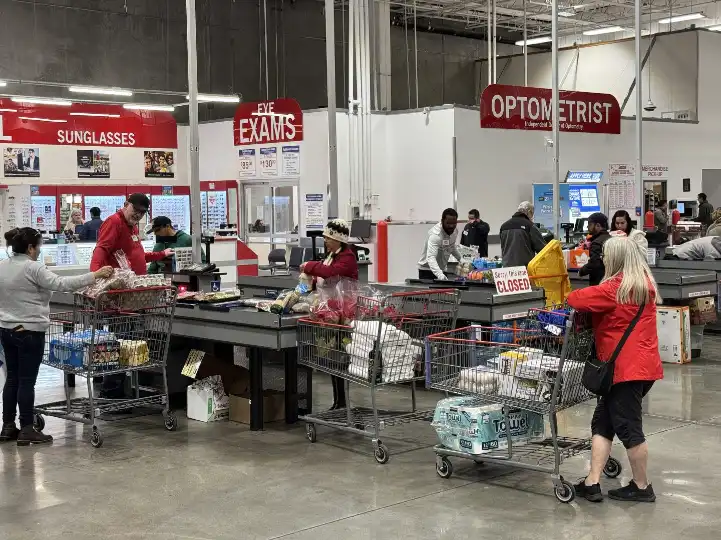
Costco takes a page from rival Sam’s Club to speed up checkout in its warehouses with ‘Scan & Pay’
Costcois testinga featurethat would allow customers to scan items in its warehouses and pay for them on their phones, following the lead of Walmart-owned rival Sam’s Club. CEO Ron Vachris offered few details on the technology, but a guide on Costco’s website said customers will receive a QR code after paying that they scan at a kiosk before exiting.Costco is turning to technology to get its customers out the door faster, a feature pioneered by rival Sam’s Club. Recommended VideoOn the company’s fiscal third-quarter earnings call, CEO Ron Vachris said the company has been quietly testing technology that would allow customers to use their phones to scan items and pay, bypassing checkout lines and improving the speed at which customers can complete their purchases.“We’ve also engaged in some ‘Scan & Go done by Costco’ kind of tests that we’re doing out there that have been extremely successful of moving people through the lines and expediting the transactions,” Vachris said on the earnings call. “We’ve seen some very, very early results that have been very positive and great adoption from our members—seeing that as well.”The name Scan & Go is trademarked by Walmart-owned rival Sam’s Club, which has been developing this type of checkout technology for years. An early version of the tech, which launched in 2013, allowed customers to scan their items in the app but required them to pay in the self-checkout lane. Later, Sam’s Club allowed customers to pay for scanned items in the app, and is now looking to replace self-checkout lanes across the U.S. with the tech.Costco CEO Vachris offered few details about its version of the technology, but a guide on the Costco website explains its Scan & Pay technology, offered in partnership with Instacart, is similar to that of Sam’s Club. By scanning items’ barcodes, customers build up a digital shopping cart which they can then pay for directly in the app and receive a QR code to scan at a Scan & Pay kiosk before exiting. Costco did not immediately respond toFortune’s request for comment.Customers have long complained about the warehouse club’s lackluster digital services and the fact it doesn’t offer the scanning technology Sam’s Club has developed for more than a decade. Now Costco is apparently embracing the idea with “several new technology pilots,” Vachris said.More than half of Costco members have downloaded the company’s app, and chief financial officer Gary Millerchip sees the company’s foray into Scan & Pay tech as a growth area for the company.“We still think there’s plenty of opportunity to keep driving higher penetration of digital engagement with our members, and we think it’s got a runway to continue to grow in the future,” Millerchip said on the earnings call.Join us at the Fortune Workplace Innovation SummitMay 19–20, 2026, in Atlanta. The next era of workplace innovation is here—and the old playbook is being rewritten. At this exclusive, high-energy event, the world’s most innovative leaders will convene to explore how AI, humanity, and strategy converge to redefine, again, the future of work. Register now.
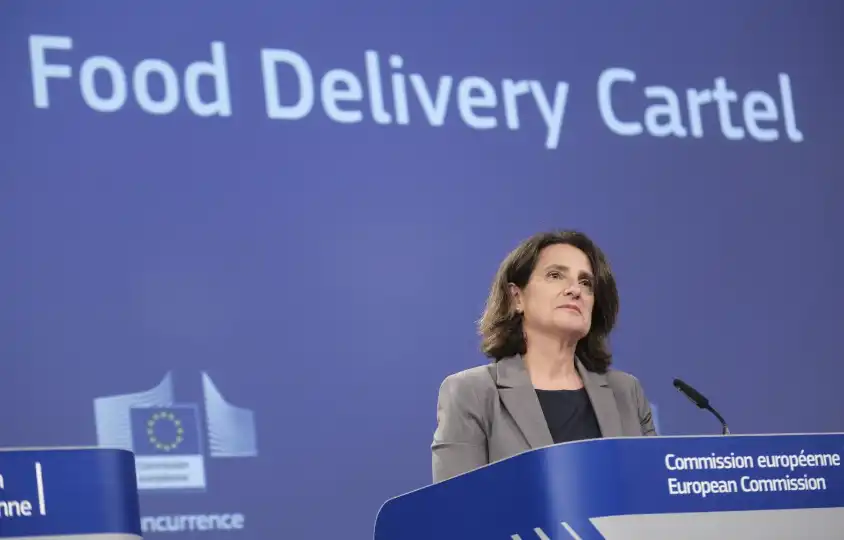
EU fines Delivery Hero and Glovo $376 million for running a food delivery cartel
The EU on Monday slapped German food delivery company Delivery Hero and its Spanish subsidiary Glovo with a fine worth 329 million euros ($376 million) after they violated antitrust rules.Recommended VideoEU regulators concluded Delivery Hero used its stake in Glovo between 2018 and 2022 to limit competition by exchanging sensitive information, agreeing not to poach each other’s employees, and to divide among themselves national markets for food delivery.Based in Germany, Delivery Hero has held a 94 percent stake in Spain’s Glovo since July 2022, but the EU’s formal probe — launched last year — focuses on the period before it took sole control.They are two of the biggest food delivery companies in Europe, delivering meals from restaurants, grocery shopping and other non-food products to customers at home ordering via their apps or websites.The European Commission, which acts as the EU’s competition watchdog, said the two companies admitted their involvement in the cartel and agreed to pay the fines to settle the case.“Cartels like this reduce choice for consumers and business partners, reduce opportunities for employees and reduce incentives to compete and innovate,” it said.Delivery Hero will have to pay a fine worth 223 million euros, while Glovo must pay around 106 million euros, the commission said.“This case is important because these practices were facilitated through an anticompetitive use of Delivery Hero’s minority stake in Glovo,” EU competition chief Teresa Ribera said in a statement.The two companies had agreed not to actively steal each other’s employees, initially covering managers before it was extended to all staff including logistics experts.Their agreement did not cover delivery drivers who were not employees at the time of the infringements, but classified as self-employed.The EU’s decision is the first where the commission finds a cartel in the labour market and Ribera said it was “also the first time the Commission is sanctioning a no-poach agreement, where companies stop competing for the best talent and reduce opportunities for workers”.Cartel by WhatsAppThe two companies exchanged commercially sensitive information regarding prices and costs via email as well as WhatsApp chats where, for example, officials would discuss which markets to enter.The commission said Delivery Hero and Glovo agreed to avoid entering countries where one company was already present, and coordinated which one should enter in markets where neither had a presence yet.As of July 2020, the two companies had fully ceased to compete with each other by carefully avoiding being present in the same markets, reducing consumer choice and thus contributing to higher prices.Delivery Hero confirmed it had reached a settlement agreement with the commission in the antitrust probe, saying it had already set aside a provision for the fine.“Today’s settlement allows Delivery Hero to address the European Commission’s concerns while allowing stakeholders to move on swiftly,” it said in a statement.Delivery Hero provides its services in more than 70 countries worldwide including 16 from the European Economic area (EEA) including the EU’s 27 states as well as Iceland, Liechtenstein, and Norway.Glovo, now Delivery Hero’s subsidiary, is present in over 20 countries worldwide, including eight in the EEA.Join us at the Fortune Workplace Innovation SummitMay 19–20, 2026, in Atlanta. The next era of workplace innovation is here—and the old playbook is being rewritten. At this exclusive, high-energy event, the world’s most innovative leaders will convene to explore how AI, humanity, and strategy converge to redefine, again, the future of work. Register now.

Burberry is cutting 1,700 jobs as its turnaround plan starts slowly reaping results
Burberry showed promise of recovering from the struggling luxury market. But now, Britain’s marquee trench coat maker will have to lick its wounds a little longer amid the slow burn of its turnaround plan. Recommended VideoOn Wednesday, the London-based company reported a 12% decline in sales in the year to March 29, marginally higher than analyst expectations of 13%. Meanwhile, its operating profit was £26 million for the same period against £418 million the previous fiscal year, reflecting the dire state of its business. “While we are operating against a difficult macroeconomic backdrop and are still in the early stages of our turnaround, I am more optimistic than ever that Burberry’s best days are ahead and that we will deliver sustainable profitable growth over time,” CEO Joshua Schulman said in a statement. Burberry is a few months into its cost-savings drive announced in November, aimed at “course correcting” and improving the brand’s performance. The primary strategy of the turnaround plan has been to lean more into Burberry’s forte, which includes outerwear like trench coats and scarves. As the company announced its full-year earnings, Burberry also said it plans to slash 18% of its workforce, or 1,700 roles, to streamline costs. The British company said the so-called “Burberry Forward” plan was already beginning to recharge the brand, although a weak first half of the year dragged its overall performance lower.By the 2027 financial year, Burberry expects to save £60 million. No dearth of challengesWhile Burberry’s better-than-expected results inject some hope into its performance, the company faces numerous challenges—some shared by other luxury players and others unique. Analysts have highlighted the indirect impact of U.S. tariff tensions on consumer confidence and appetite for luxury goods. The broader luxury sector has been concerned about flagging consumer confidence over the last two years, which has only recently shown signs of rebounding.Burberry’s business in Asia Pacific, which contributes 44% of its revenue, has been struggling from the luxury slowdown. Meanwhile, the U.S. clocked in a stronger performance in the third quarter, when investors seemed encouraged that luxury may have finally turned a corner. The fourth quarter, although better than expected, saw sales in the Americas contract by 4%. For its part, Burberry’s strategy of doubling down on core-product campaigns could help strengthen the brand’s allure once again, but it may not be able to single-handedly lift sales. “Burberry’s signature trench coat, while an undisputed icon, poses a business challenge. As a lifetime product, it naturally limits the frequency of repeat purchases—unlike trend-driven items that bring customers back season after season,” Yanmei Tang, an analyst at Third Bridge, wrote in a note Wednesday. Separately, Burberry’s “elevated” pricing strategy also backfired at a time when shoppers were tightening their purse strings. Schulman admitted the brand had strayed from its path and become “inconsistent” with what it stood for. Not long after Schulman took over in July, the company lost its spot on the U.K.’s benchmark FTSE 100 Index.The turnaround plan may take a while to reap results, but Deutsche Bank analysts led by Adam Cochrane wrote that they “like the Burberry story” and see Burberry “showing further progress.”Join us at the Fortune Workplace Innovation SummitMay 19–20, 2026, in Atlanta. The next era of workplace innovation is here—and the old playbook is being rewritten. At this exclusive, high-energy event, the world’s most innovative leaders will convene to explore how AI, humanity, and strategy converge to redefine, again, the future of work. Register now.
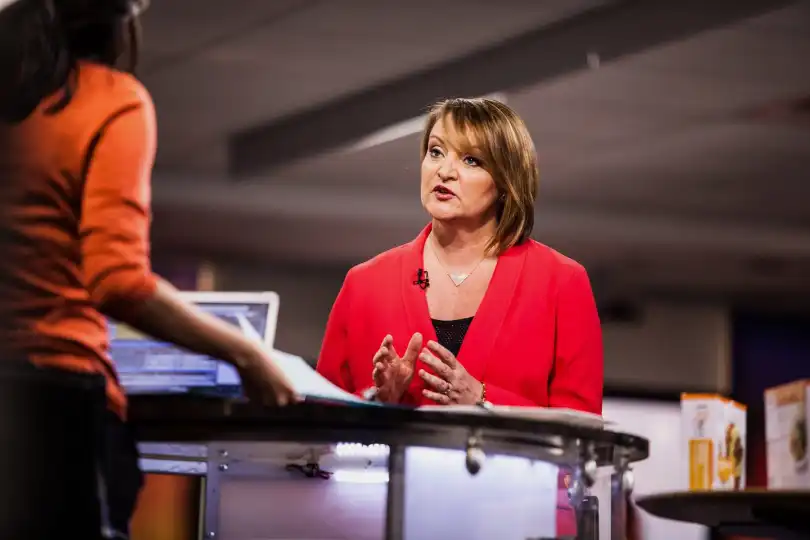
A Kohl’s board member resigned because she was ‘continually disappointed’ by governance and a lack of transparency. The retailer denies there was any friction
A board member at Kohl’sresigned because she said there were governing issues and a lack of transparency at the beleaguered retailer. The company denies Day’s statements, and its SEC filing regarding Day’s resignation said her decision was “not due to any disagreements with the company.”The drama at Kohl’s continues. Just days after CEO Ashley Buchanan was fired over striking a “highly unusual” deal with a vendor he had a personal relationship with, a board member has resigned. Christine Day, who previously served as CEO of athletic wear company Lululemon, filed her resignation letter on May 5, just four days after Buchanan’s booting. Recommended VideoAccording to a May 9 8-K SEC filing, Day emailed Kohl’s directors Jonas Prising and John E. Schlifske—as well as Jennie Kent, Kohl’s chief legal officer and corporate secretary—to let them know she wouldn’t be joining a May 5 “comp call” because she decided to resign from the board effective immediately. Later that morning, Day followed up with a direct email to Schlifske formalizing her resignation. She had served on the board of directors since April 2021, an SEC filing shows.In further emails dated May 9, Day said she was “continually disappointed with the level of governance process” and a lack of transparency. Kohl’s, however, had pre-empted Day’s detailed resignation emails with an 8-K filing of its own just one day prior on May 8, which said “Ms. Day’s decision was not due to any disagreements with the company on any matter relating to the company’s operations, policies or practices.”It’s also important to recognize Day had sent two resignation letters to Kohl’s simply stating she was leaving the board. It wasn’t until after Kohl’s released its initial 8-K filing that Day had elaborated on the reasons for her resignation. However, Day wrote in one of the emails released in the May 9 filing: “There is simply no way the board could have interpreted my resignation as having no conflict issues.”“This was a deliberately selective edit. So you will have to correct the filing as a misstatement. Not an after-the-fact email,” she continued. In that 8-K filing, Kohl’s said it “strongly disagrees” with the assertions in Day’s emails. Kohl’s declined to provide further statement about Day’s resignation.According to the emails released in the 8-K, Day was specifically concerned about how the company handled a report by proxy-advisory firm Institutional Shareholder Services (ISS), in which ISS was against a vote to ratify the new CEO’s compensation because of concerns about its size, disclosure, and structure of Buchanan’s awards.When Buchanan was fired after only 100 days in the post, he was told he had to reimburse Kohl’s for part of his $2.5 million signing bonus. However, ISS said in the report shared withFortunethat even though Buchanan had to pay back part of his bonus, “there remains concern with the company’s prior decision to originally grant these large awards, which entirely lack performance criteria.”In the emails shared in the 8-K filing, Day alleges Kohl’s didn’t respond to ISS and shared “material information with only select shareholders,” while also accusing interim CEO Michael Bender of not disclosing this information to all board members.“As directors, we all get sued together—so transparency with risks is a requirement for trust and accountability,” Day wrote. “To place other directors in [the] position of making a decision without full disclosure of risks is unacceptable. And it has been going on far too long.” She was also originally expected to become chair of the compensation committee, according to the ISS report.Day didn’t address other instances in which directors were placed in a similar situation, and she could not be reached for comment.The emails shared in the 8-K filing allude to “several other issues” about a lack of disclosures, but some of the information is redacted.“ There is no delegation to committees or chairs, Michael ‘handles’ everything, maybe speaks to one person or 2, then ‘tells’ everyone what the decision is,” Day wrote. “Some people know more than others leading to board members feeling alienated, out of the loop, and worse—developing a culture where real discussions rarely occur.”Aside from Buchanan’s firing and Day’s resignation, Kohl’s has been struggling financially for a while. The company’s fourth-quarter net sales dropped 9.4%, it had to cut its dividend, and changed its guidance for a 5%-to-7% decline in 2025. Plus, the company announced store closures and layoffs this year. “Itʼs a hot mess,” Carol Levenson, chief research officer and director of U.S. investment grade research at Gimme Credit, toldFortunein a statement. “Poor sales performance, the threat of the resumption of paused Asian tariffs, and governance turmoil combined with strained liquidity requiring last-minute financial maneuvers” all led Gimme Credit to dub Kohl’s with a “deteriorating” credit score.Join us at the Fortune Workplace Innovation SummitMay 19–20, 2026, in Atlanta. The next era of workplace innovation is here—and the old playbook is being rewritten. At this exclusive, high-energy event, the world’s most innovative leaders will convene to explore how AI, humanity, and strategy converge to redefine, again, the future of work. Register now.

E.l.f.’s acquisition of Hailey Bieber’s Rhode is a $1 billion bet on Gen Alpha
Budget beauty giant e.l.f. has finalized a $1 billion deal to acquire Rhode, social media influencer Hailey Bieber’s skincare brand. Rhode generated $212 million in net sales in the past 12 months ending in March 31. E.l.f CEO Tarang Amin toldFortunehe sees the brand as having “real staying power.”Budget beauty giant e.l.f. continues its wooing of Gen Z and Gen Alpha consumers with a deal to buy influencer Hailey Bieber’s cosmetic brand Rhode.Recommended VideoThe Oakland-based cosmetics company signed a definitive agreement to acquire Rhode in a deal valued at $1 billion, the company announced Wednesday. The deal consists of $800 million in cash and stock to be paid at closing, as well as a potential $200 million in earnout consideration over the next three years, contingent on Rhode’s performance after the sale.“We found a like-minded disruptor in Hailey Bieber and the Rhode team,” e.l.f CEO Tarang Amin toldFortune. “I’ve been in the consumer space for 34 years. I’ve never seen a business like this….It’s just incredible the level of consumer fervor and community that this brand has been able to build.”Founded in 2022, Rhode launched with three products, marketing itself as a minimalist, curated brand of essential must-haves, bolstered by Bieber’s own popularity. Bieber, the daughter of actor Stephen Baldwin and now married to pop star Justin Bieber, has garnered a following of 55 million on Instagram and more than 15 million on TikTok. Rhode generated $212 million in net sales in the past 12 months ending in March 31, according to the press release. Bieber was considering selling the brand last month,Reutersfirst reported, tapping JPMorgan Chase and Moelis to help with the deal.Rhode, built as a direct-to-consumer brand, will also make its brick-and-mortar retail debut, selling its products in U.S.,Canada, and UK Sephora locations by the end of the year.E.l.f. announced the acquisition alongside its fourth-quarter and full fiscal 2024 earnings, posting $332.6 million in quarterly net sales, a 4% year-over-year increase, as well as a 28% boost in year-over-year annual net sales to $1.3 billion. The company did not provide fiscal 2026 guidance due to tariff uncertainty.Gen Alpha mixes beauty and wellnessAmin hailed e.l.f.’s ability to attract Gen Z and Gen Alpha shoppers, saying, “We have the consumers everyone wants.”While the young generation has a trepidatious economic outlook, they are willing to spend on skincare and beauty. According to Piper Sandler’s spring 2025 Taking Stock with Teens survey of 6,455 teenagers, 57% of respondents had a worse outlook on economic trends compared to 19% who reported a better outlook. Yet teenagers increased their spending from the prior year, and the beauty category led the way with $374 in spending, a 10% year-over-year jump. Teenagers ranked e.l.f. as their top beauty brand. E.l.f.’s acquisition of Rhode aligns with Amin’s observations around Gen Alpha and Gen Z’s growing interest in wellness as a complement to cosmetics.“We see a real blurring of the lines, actually, even between cosmetics and skincare,” Amin said. “Having skincare benefits in even your cosmetics has proven to be really successful for us.”Rhode’s products like Peptide Lip Treatments and Glazing Milk toner encapsulate this marriage of skincare and beauty. Bieber’s “glazed donut skin” technique of applying products to make one’s face appear glossy like the eponymous confection went viral on social media.While e.l.f. is betting on Bieber’s vision, not all collaborations between beauty brands and social media stars have paid off. Sephora pulled the product lines of Addison Rae’s Item Beauty and Hyram Yarbro’s Selfless by Hyram in 2023 after launching the respective partnerships in 2021. Amin said e.l.f.’s new acquisition would not suffer the pitfall of short-lived hype.“Rhode is a brand where consumers will camp out overnight, wait 14 hours in a line for a pop-up in LA, not not just for the product, but to buy into the entire lifestyle of the brand,” Amin said. “So that is the thing that we believe has real staying power: her instincts, her aesthetic, her vision for this brand.”Join us at the Fortune Workplace Innovation SummitMay 19–20, 2026, in Atlanta. The next era of workplace innovation is here—and the old playbook is being rewritten. At this exclusive, high-energy event, the world’s most innovative leaders will convene to explore how AI, humanity, and strategy converge to redefine, again, the future of work. Register now.
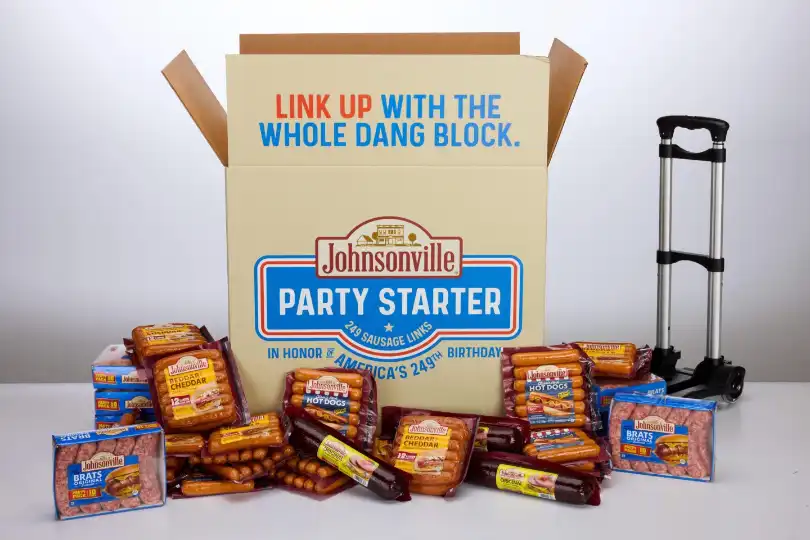
A different kind of Brat summer: Johnsonville will offer an 80-pound, 249-link variety pack of sausages, brats, and hot dogs, which comes with its own hand truck
Johnsonville is offering an 80 lb, 249-link box of sausages. The promotional item will be sent to winning entrants right before July 4 of this year. It comes with its own hand truck.Memorial Day is the start of cookout season—and if you want to be the talk of the neighborhood (or, if you’re greedy, the local hospital’s cardiac ward), Johnsonville might have just the product for you.Recommended VideoThe sausage company will roll out the Johnsonville Party Starter this summer: an 80-pound, 249-link collection of bratwurst, Cheddar smoked sausage, and hot dogs. And you won’t have to pay a dime for it or figure out how to fit it into your car’s trunk.The promotion for the BBQ feast runs through June 16. Winners will be chosen the following day and the Party Starter packs will be shipped to winners the week of June 30, just in time for a blowout Fourth of July cookout.To win, you’ll need to write a short—really short—essay saying why you should receive the kit. You’ll have 249 characters to plead your case. Head to the company website to enter.Why the emphasis on “249” with this promotion? The summer of 2025 will mark the country’s 249th birthday. While next year will likely see promotions galore from companies and the government, Johnsonville wanted to get started on celebrating a bit early.“We know lots of organizations—even the White House—are focused on America’s 250th in 2026,” said Jamie Schmelzer, vice president of marketing at Johnsonville. “But the data is clear: America needs fun now. We’re encouraging people to celebrate our 249th because many of us agree that having fun together is an important part of making progress.”In addition to the meatapalooza, winners will receive company swag and a hand cart to help them bring all those links to the grill. You’re on your own for side items, though.Join us at the Fortune Workplace Innovation SummitMay 19–20, 2026, in Atlanta. The next era of workplace innovation is here—and the old playbook is being rewritten. At this exclusive, high-energy event, the world’s most innovative leaders will convene to explore how AI, humanity, and strategy converge to redefine, again, the future of work. Register now.
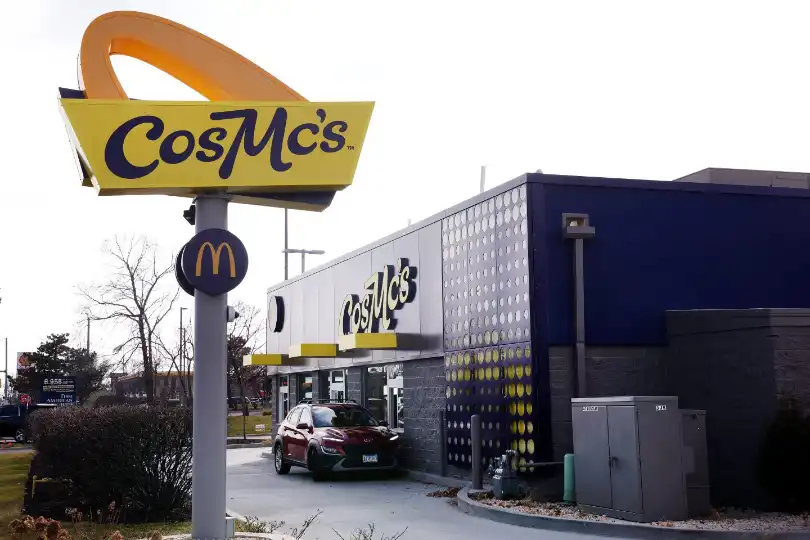
McDonald’s pulls the plug on beverage-focused CosMc’s
McDonald’s is shutting down all of its CosMc’s locations. The doors will begin closing at the end of June. Some of the most popular drinks at the Starbucks competitor will make it onto the main menu at McDonald’s.CosMc’s, the McDonald’s spinoff meant to compete against Starbucks, is calling it quits.Recommended VideoThe fast-food chain has announced plans to close all five CosMc’s locations next month after less than two years in business. It’s a big turnaround for the side business that last year reportedly received more than twice as many visits as a typical McDonald’s over the same time period.McDonald’s had planned to open 10 CosMc’s locations, but in January of this year, it closed three locations, opening two others in new locations. All locations will be closed in late June.“What started as a belief that McDonald’s had the right to win in the fast-growing beverage space quickly came to life as a multi-location, small format, beverage-focused concept,” the company said in a statement. “It allowed us to test new, bold flavors and different technologies and processes—without impacting the existing McDonald’s experience for customers and crew. By creating a Learning Lab—in a way that only McDonald’s can—the CosMc’s team was able to test-and-learn in real customer-facing environments, which allowed for greater agility and speed.”Some of the most popular CosMc’s drinks will make it onto the menu at standard McDonald’s. The company did not say which those would be, but the most popular offerings as of late January were the Sour Cherry Energy Burst, the Churro Cold Brew Frappe, and the Island Pick Me Up Punch.CosMc’s revolves around a character introduced in 1987—a robot, of sorts, with a green head, a fishbowl-like body, and arms and legs. In his commercial, he tells Ronald McDonald and Grimace that he “popped in from outer space on a trade mission,” but proceeds to swap less than desirable objects for a burger and fries. He’s ultimately stopped via a giant magnet, but joins the gang for a picnic.Join us at the Fortune Workplace Innovation SummitMay 19–20, 2026, in Atlanta. The next era of workplace innovation is here—and the old playbook is being rewritten. At this exclusive, high-energy event, the world’s most innovative leaders will convene to explore how AI, humanity, and strategy converge to redefine, again, the future of work. Register now.

Arby’s is selling a $85 outfit made entirely of napkins
Arby’s is introducing a shirt and shorts it says are made entirely of napkins. The rollout comes as the chain introduces new BBQ sandwiches.In the world of fast fashion, many clothes are virtually disposable these days. Arby’s is taking things to the next level.Recommended VideoWith National Barbeque Day approaching on May 16, the fast-food chain has introduced a button-down shirt and matching pair of shorts, which are made entirely of napkins. Dubbed the 13 Hour Drip Fit, the complete outfit will cost $85. (Fast fashion might be cheap, but napkin duds? Not so much.)You can buy one at 13hrdripfit.com.Courtesy: Arby’sThe outfit was designed in collaboration with the Chain brand. Both the shirt and shorts are white (because what fun is it to drop sauce on an outfit that won’t let you revel in the mess?), with red stripes and, natch, the Arby’s logo.While Arby’s says the outfit is entirely made of napkins, that doesn’t look to be entirely true. The shorts appear to have an elastic band to keep them up (and accommodate for an increasingly full stomach) and are secured by what appears to be a cotton drawstring. And, of course, the shirt’s buttons are plastic. To be fair, the company never said the napkins were paper.The outfit drops at the same time as a new BBQ line of sandwiches from Arby’s, including a quarter-pound brisket and quarter-pound pulled pork sandwich.“With the 13-Hour Drip Fit, we wanted to bring the slow-smoked swagger of our BBQ to life in a way you can wear. Made entirely from napkins, it’s fashion that says, ‘I came hungry,” said Jeff Baker, chief marketing officer at Arby’s.Yes, you could wear a bib. You could tuck a napkin into your shirt. Or you could, you know, wash your clothes after you dribble sauce or brisket juice onto your clothes. There’s even the option to carefully eat your sandwich and not make a mess, but what fun is that?Join us at the Fortune Workplace Innovation SummitMay 19–20, 2026, in Atlanta. The next era of workplace innovation is here—and the old playbook is being rewritten. At this exclusive, high-energy event, the world’s most innovative leaders will convene to explore how AI, humanity, and strategy converge to redefine, again, the future of work. Register now.
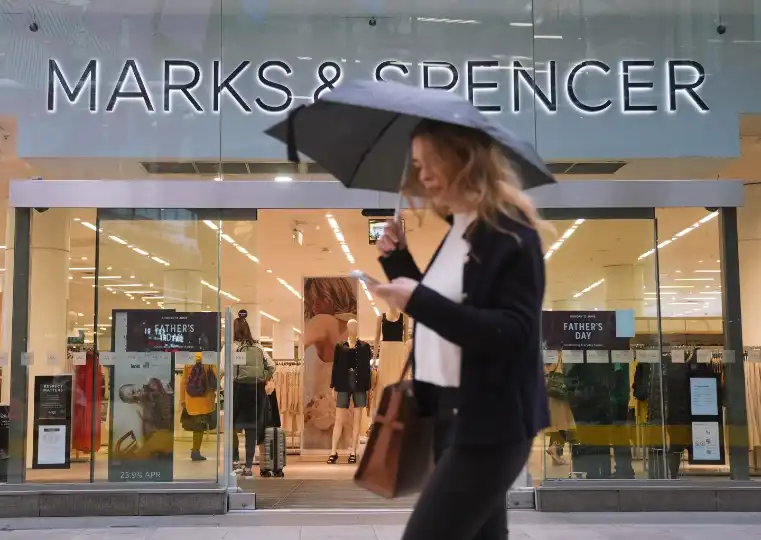
The $404 million cyberattack: Britain’s M&S faces pay hit and expects disruption to last through to July
British clothes-to-food retailer Marks and Spencer on Wednesday said a cyberattack affecting its online service is set to last through to July and cost the group £300 million ($404 million).Recommended VideoMarks last week revealed that some personal data of its customers had been stolen in a cyberattack that has crippled its online services for weeks.“In Fashion, Home & Beauty, online sales and trading profit have been heavily impacted by the necessary decision to pause online shopping, however stores have remained resilient,” Marks said in a statement.“We expect online disruption to continue throughout June and into July as we restart, then ramp up operations.”The impact on annual group operating profit is estimated at “around £300 million… which will be reduced through management of costs, insurance and other trading actions”, the retailer added.The news came as Marks on Wednesday reported operating profit before adjusting items of £985 million for its financial year to the end of March.Following the update, its share price dropped 2.5 percent at the start of trading in London.Group operations have since Easter been hampered by a ransomware sting which forced the retailer to suspend online sales, contactless payments instore and even recruiting operations.Marks said information stolen could include names, dates of birth, home addresses and telephone number. However, it did not include “useable payment or card details”, nor account passwords.The company reported the incident to relevant government authorities and law enforcement.A wave of cyberattacks have hit British retailers in recent weeks, including luxury department store Harrods and the Co-op food chain.Join us at the Fortune Workplace Innovation SummitMay 19–20, 2026, in Atlanta. The next era of workplace innovation is here—and the old playbook is being rewritten. At this exclusive, high-energy event, the world’s most innovative leaders will convene to explore how AI, humanity, and strategy converge to redefine, again, the future of work. Register now.

Memorial Day 2025 deals: Best freebies and discounts for veterans
America is taking a day to say thank you to those who have served in the military and honor those who made the ultimate sacrifice. And many businesses are doing so by offering extra discounts and freebies to active duty military and veterans.To take advantage of these deals, you’ll likely need your military ID. So keep that handy. Here are some of the most notable specials being offered.WalgreensFrom May 24-27, veterans, members of the military and their families can get a 20% discount on eligible regular-price items at Walgreens or Duane Reade stores.Columbia SportswearWhile the retailer is offering sale prices to everyone, military personnel (and first responders) can get an extra 20% off from May 16 though May 27.Sea WorldActive-duty military and their families receive free admission to SeaWorld and Busch Gardens parks. (Can’t make it today? The offer runs year-round.)7-ElevenThe chain is doubling its fuel discount for active-duty and retired members of the military. Through May 31, verified 7Rewards and ID.me members can take 10 cents off per gallon—along with the app’s normal 5 cent discount.MidasNeed tires or a repair to your vehicle? Midas is offering active military members and veterans an extra 15% off.Pilot Flying JAll month long, the travel-center chain has been offering three free offers per week to veterans, military personnel and their families. Those include free Pilot coffee and fountain drinks, freshly prepared Pilot foods like pizza and breakfast sandwiches, and popular brand name cooler drinks.Outback SteakhouseTake 10% off your bill with a military ID, not just today, but every day.Kings DominionThe Virginia theme part is offering free admission to active and retired military. Dependents receive tickets for up to six people at a 50% discount.
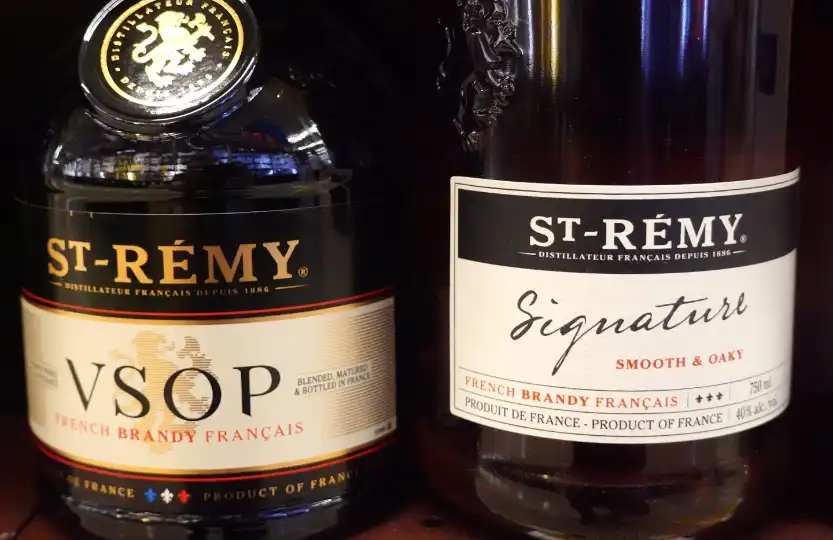
Remy Cointreau names Marilly as CEO after Vallat steps down
Remy Cointreau SA appointed former Chanel executive Franck Marilly to replace outgoing Chief Executive Officer Eric Vallat.Recommended VideoMarilly, who will start on June 25, joins at a critical juncture for the Paris-listed group, which is facing tariff concerns in two of its key markets. Vallat had said last month he would be stepping down this summer.Remy’s shares, which had slumped more than 45% in the past year through Tuesday’s close, slipped 0.7% in early trading in Paris.Remy and rival Cognac makers have been under pressure from an anti-dumping investigation in China, which has imposed temporary duties on imports of the French brandy. Duty free channels have been suspended, prompting a further drop in Cognac sales in its most recent results.The company has also faced concerns about potential import tariffs in the US.The “timely” appointment is likely to be welcomed by investors, Morgan Stanley analyst Rashad Kawan said in a note, adding that Marilly’s experience as a trade adviser to the French government since February has “potential merits” in the context of global trade tensions.Marilly, who has also previously worked at Unilever Plc, left Japanese cosmetics maker Shiseido Co. this month. He joins Remy as it begins a €50 million ($56.5 million) cost-cutting plan.Join us at the Fortune Workplace Innovation SummitMay 19–20, 2026, in Atlanta. The next era of workplace innovation is here—and the old playbook is being rewritten. At this exclusive, high-energy event, the world’s most innovative leaders will convene to explore how AI, humanity, and strategy converge to redefine, again, the future of work. Register now.
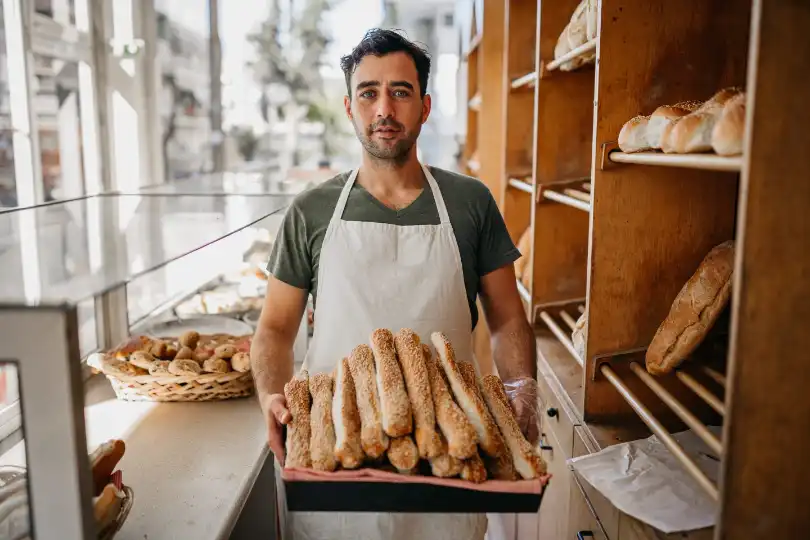
Let them eat cake! French bakeries are protesting because opening on May 1 is (possibly) against the law
Knowing if you can open your business on a public holiday should seem straightforward, but the situation is less clear-cut for bakers across France.Recommended VideoAs in other countries, May 1 is Labor Day, a celebration of worker rights, and employees have the right to the day off. An exception exists for essential businesses and services, such as hospital workers. So, the issue is less about whether bakeries can open on Labor Day and more about whether bakers should ask employees to work.Over the years, a baker’s “need” to stay open has been open to interpretation. Some bakers remain open, selling goods they baked the day before, while some owners open without staff. Some employees reportedly show up to work, albeit voluntarily and paid. Some bakers open if they provide prisons or retirement homes with bread. Others open anyway. And it has been this way for decades.So, if bakers have flouted the rules for years, why the fuss now? This time last year, inspectors unexpectedly fined five bakeries in the Vendée region of France because their employees worked on May 1. All were recently acquitted because the legal team was able to argue that it was a tolerated practice, and the legal wording was open to interpretation. But it has kicked off a debate that has been rumbling for years. Bakers complain of the risk of unannounced inspections and unfair, heavy fines if they open on Labor Day.A boulangerie is still central to the French way of life. The French eat an estimated 320 baguettes every second, half a baguette per person daily, and 10 billion annually. According to a 2017 government report, half the country lives within 1.4 miles of a bakery “as the crow flies. ” In cities, 73% of the population lives within less than half a mile. Bread is forever tied to French history and its revolution via Marie Antoinette’s infamous quote “Let them eat cake” (although it’s commonly thought that the phrase is “Let them eat brioche”—and that she didn’t say it). French philosopher Rousseau used it in 1767, probably to describe the aristocracy in general. But ever since the revolution, the notion of every French person having access to bread has been enshrined in law.Bread needs to be made on the premises to be considered a boulangerie, and a baguette is only a baguette if it hasonlyfour ingredients: flour, water, yeast, and salt. It is baked in a steam oven to achieve a crispy texture. Since the 1920s, baguettes must weigh between 250 to 300 grams and be no longer than 65 centimeters. In 2022, the baguette was added to the UNESCO list of Intangible Cultural Heritage because it requires a specific skill and knowledge to make and is integral to French culture.To try to solve the baking quandary, French Union Centrist (UC) senators have tabled a new bill to “allow employees of certain establishments and services to work on May 1st.” This bill is primarily aimed at bakeries but also applies to similar businesses, such as florists.The bill aims to remove legal ambiguities and allow businesses to open as they can on Sundays, should they choose to. Advocates argue that bakers should be able to guarantee an “essential local service” while paying more to people who choose to work on those days.Catherine Vautrin, the French minister of labor, supports the notion, telling France24 that “the government will support this initiative because it protects the rights of citizens and meets the expectations of bakers and other essential workers.” She believes it will bring legal clarity, but stipulates that employees must decide to work voluntarily.Trade unions are unhappy. They believe it calls into question the nature of the day itself; that it undoes the progress, as reported byLe Monde,that unions have made since the 19th century. Many unions fully support inspecting premises and possibly issuing fines. These fines range from €750 to €1,500 per employee caught working.For many bakers, there is a business imperative to open on May 1: Some bakers can sell more bread than on a typical business day. For example, the Maison Collet bakery in Paris can sell 1,300 baguettes and 1,000 pastries on May 1, compared to 800 and 360 on regular business days.French consumers seem divided on the issue. Some hope to continue protecting the rights of workers enshrined in law, while others believe the rules that worked in 19th-century France might not apply to the modern 21st-century workforce, society, and consumer behavior.It might only be something that a change in law can resolve.Join us at the Fortune Workplace Innovation SummitMay 19–20, 2026, in Atlanta. The next era of workplace innovation is here—and the old playbook is being rewritten. At this exclusive, high-energy event, the world’s most innovative leaders will convene to explore how AI, humanity, and strategy converge to redefine, again, the future of work. Register now.
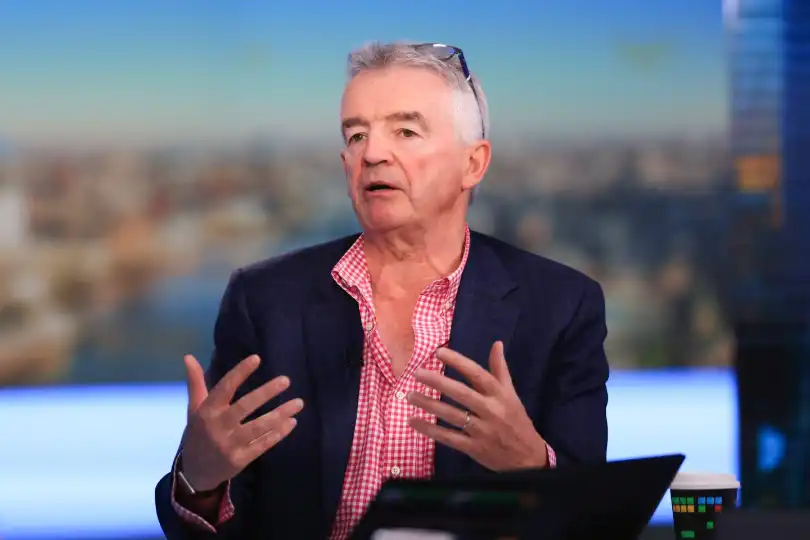
Ryanair fares set to rise by nearly 20% as airline plots profit rebound
Ryanair fares are set for a sharp rise as the airline attempts to rebound from a double-digit hit to profits in a year where Ryanair shipped a record number of passengers.Recommended VideoEurope’s largest airline transported a record 200 million passengers in 2024, though fares were 7% lower than in the year prior. Ryanair’s CEO, Michael O’Leary, said high inflation and interest rates, an off-cycle Easter, and a fall in travel agency bookings forced the company into “repeated price stimulation” last year, in other words, price cuts. Net profit fell 16% in Ryanair’s financial year as it cut ticket prices to boost passenger numbers.The airline is now hoping to recoup that average fare reduction this year, and in turn return to profit growth, as European consumers look better positioned than last year to spend through the Summer. As part of that plan, the airline expects fares to rise by “a mid-high teen percent ahead of Q1 FY25,” compared with the same period last year. Much of that is attributable to the timing of Easter, which fell in April this year and fed into higher average flight prices. The airline said tariffs, geopolitical conflicts, and as yet unrealized problems with air traffic control created potential barriers to its recovery.Profit after tax slid to €1.61 billion ($1.8 billion) in the 12 months to the end of March for the airline that flies mostly across Europe, Ryanair said in an earnings statement. Revenue increased four percent to €13.95 billion. A seven percent drop in fares saw passenger numbers rise to just over 200 million, up from almost 184 million passengers the previous year.“We cautiously expect to recover most, but not all, of last year’s seven percent fare decline, which should lead to reasonable net profit growth” in its latest financial year, the company said.O’Leary signalled optimism for the peak summer season ahead.“We are seeing robust summer 2025 demand across the network. Our forward bookings are strong,” he said in an online presentation on Monday.Shares in Ryanair jumped around 3.5% in morning deals in Dublin after the results slightly beat analyst expectations.It also launched a €750 million share buyback programme over the next six to 12 months.Ryanair’s staff costs increased by 17% to €1.75 billion last year ($1.97 billion), owing to a larger plane fleet.Despite the profit drop, Ryanair is “more bullish for this year, highlighting that demand is robust across Europe”, said Susannah Streeter, head of money and markets at Hargreaves Lansdown.“Travellers are brushing off economic uncertainty and appear determined to ring-fence available budgets to spend on trips abroad,” she added.‘Improving’ Boeing delaysThe airline warned that it expects just three percent growth in passenger numbers by March 2026 due to delayed Boeing deliveries. Ryanair has lowered its growth forecasts several times as manufacturing issues at the US aircraft maker continue to affect Europe’s biggest airline by passenger numbers. In its earnings, Ryanair reminded investors it had achieved record passenger numbers last year “despite” delays to Boeing deliveries. But O’Leary noted on Monday that these delays are “improving”.Boeing had a bruising 2024 that included a labour strike of more than seven weeks, major safety issues on commercial planes, and defence contract cost overruns.O’Leary cautioned last month that Ryanair may defer deliveries of new Boeing jets should the fallout from US President Donald Trump’s tariffs make them more expensive.Trump’s tariffs, including on key aircraft materials aluminium and steel, together with retaliatory levies risk hitting global supply chains, in turn hiking costs across sectors.Join us at the Fortune Workplace Innovation SummitMay 19–20, 2026, in Atlanta. The next era of workplace innovation is here—and the old playbook is being rewritten. At this exclusive, high-energy event, the world’s most innovative leaders will convene to explore how AI, humanity, and strategy converge to redefine, again, the future of work. Register now.
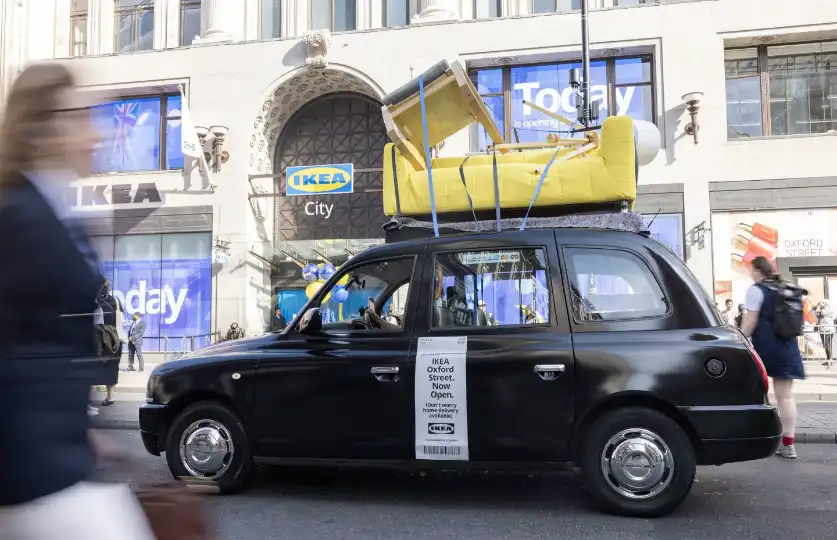
Ikea’s new central London store has learned from ‘a lot of mistakes’ over 7 years—but it’s confident its inner-city debut will click with shoppers
When you enter Ikea’s freshly opened Oxford Street store in London, two things instantly meet your eye: a display of the company’s newest furniture line and some very bright colors. The long-awaited store, which looked like a mega blue Frakta bag when in the works and was initially slated to open in 2023, finally welcomed shoppers on Thursday. It’s not a common sight for an Ikea store to be smack in the middle of the city, and in a location that’s Europe’s most popular shopping destination, receiving a whopping 30 million yearly visitors. But Ikea knows what it’s up against and has tweaked its city store format to account for its location. The store features new concepts, like a 25-square-meter live studio and colorful collections curated by Londoners. It also boasts a souvenir section by the entrance to attract fast-footed tourists. The colorful street level of Ikea’s new London store.Courtesy of IkeaThe marketplace section, keeping affordability front and center, offers a range of kitchen items for £3 and under. “We have been on to this for the last seven years, and we have [made] a lot of mistakes when designing city location stores,” Tolga Öncü, Ingka Group’s retail manager (COO) at Ikea Retail, toldFortunein an interview following the store opening. He gave the example of Ikea’s Paris store, where it did away with its serpentine format, thinking people would want to pop in and out without necessarily exploring all sections. But Parisians preferred the original format. Formerly the Topshop flagship store, the new Ikea boasts a range of 3,500 products on display, with another 2,500 available for pickup. Given the busy neighborhood and tricky parking availability compared with some suburban locations, Ikea will limit the size and type of furniture people can collect or buy in Oxford Street.The bedding section at the Ikea Oxford Street store.Courtesy of Ikea“We have also learned over the last seven years which category of products people are more eager to bring home from the city location,” Öncü said, adding that small accessories are popular, while people are willing to wait a few days for sofas to ship to their homes. Ikea may have had to make different choices for furniture at its Oxford Street store, but its 130-seater Swedish deli, featuring meatballs and hot dogs, will be present in all its glory. Öncü pointed out one design tweak key to this location—food will only be served in takeaway boxes to account for people working in the area who might want to grab a quick, low-cost meal.London City problemsThe company has other city-center stores in Stockholm and Mumbai. It’s also no stranger to London, having opened its Hammersmith store in West London in 2022 and a stand-alone restaurant next to it last year. This foray offered hints into what Londoners are looking for as the cost of living continues to stretch their wallets. One of British retailers’ biggest concerns in recent years is the uptick in shoplifting, which costs them £2 billion a year, according to the British Retail Consortium. Ikea said that while it has stationed a security team across the store and made the checkouts clear to mitigate the risk of theft, it also wants to make sure it appears welcoming to shoppers. The mostly underground Ikea store might struggle with queues as it has only a handful of tills two floors below street level. However, Ikea said it plans to introduce a scan-and-pay system whereby customers can skip the checkout counters by simply scanning to purchase an item.In a bid to make the area more suitable for shopping, Ikea’s U.K. chief Peter Jelkeby has backed Mayor Sadiq Khan’s bid to pedestrianize Oxford Street. Khan has advocated for this to boost the strip following the crop of shops selling U.S. candy and the pandemic’s impact on general business in the area. The Westminster City Council has opposed Khan’s plan owing to disability access and public transport disruption. Khan said Ikea’s big debut is “a huge vote of confidence in London, in our economy, and in our plans to rejuvenate Oxford Street and unlock its true potential.”Öncü said the upside of a pedestrianized Oxford Street is that shoppers will be more at ease, especially if they accompany children. “As a retail concept, the more relaxed our visitors are, the more time they will spend; the more time they spend, the more time we have to do business,” he said. The Ikea store, which was led by Ingka Group’s investment arm, marks a new spurt of U.K. stores to follow in Brighton and Norwich.Join us at the Fortune Workplace Innovation SummitMay 19–20, 2026, in Atlanta. The next era of workplace innovation is here—and the old playbook is being rewritten. At this exclusive, high-energy event, the world’s most innovative leaders will convene to explore how AI, humanity, and strategy converge to redefine, again, the future of work. Register now.
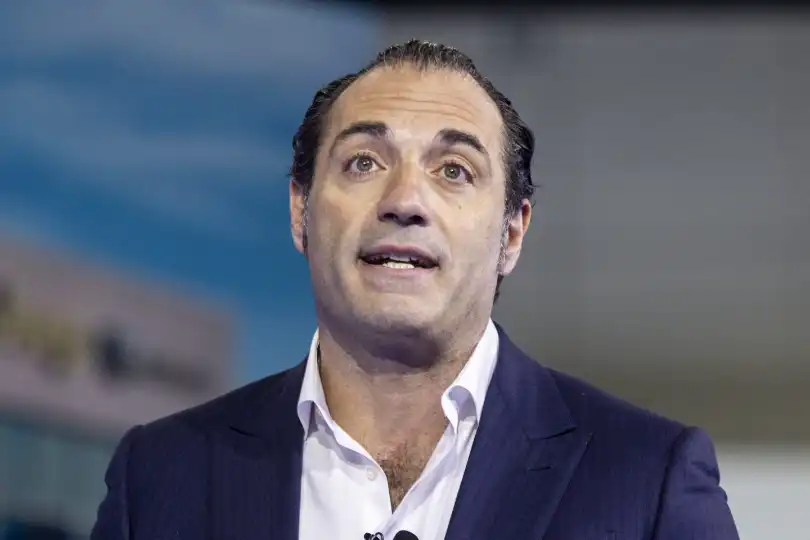
Auto giant Stellantis appoints 25-year company veteran—Antonio Filosa—as new CEO to lead turnaround
Auto giant Stellantis, whose brands include Jeep, Peugeot and Fiat, on Wednesday named company veteran Antonio Filosa as its new chief executive officer as the US-European group navigates US tariffs and slumping North American sales.Recommended VideoThe Italian manager, who has led Stellantis in North and South America, will succeed Carlos Tavares, who abruptly quit in December.Filosa was unanimously selected by the board following a “thorough search process of internal and external candidates”, Stellantis said in a statement.Stellantis said it would call an extraordinary shareholder meeting in the coming days to elect Filosa to the board to serve as an executive director of the company.“Meanwhile, to give him full authority and ensure an efficient transition, the Board has granted him CEO powers effective June 23,” the statement said.“The Board selected Antonio Filosa to be CEO based on his proven track record of hands-on success during his more than 25 years in the automotive industry,” Stellantis said.The company also praised “the depth and span of his experience around the world, his unrivalled knowledge of the Company and his recognised leadership qualities”.Tavares: good times, bad timesStellantis, whose other brands include Ram trucks, Dodge, Chrysler and Maserati, has struggled with falling sales in its key North American market.US President Donald Trump’s 25-percent tariffs on the car industry has added to the company’s woes.Last month, Stellantis dropped its annual financial guidance due to uncertainty over the levies.Filosa, who has previously served as chief executive of the Jeep brand, was promoted to the role of chief operating officer for the Americas region in December.“Since his appointment, he has initiated the strengthening of the US operations,” Stellantis said, noting that he “significantly” reduced excessive inventories at dealerships and reorganised the leadership team.Tavares engineered one of the most ambitious mergers in automotive history in 2021 when more than a dozen brands, including Jeep, Fiat, Chrysler, Peugeot and Citroen, were put under the same roof.The Portuguese executive, who headed French group Peugeot-Citroen at the time, was appointed chief executive of the newly created French-Italian-American behemoth Stellantis.His three-year tenure was marked by high profit margins that were the envy of its rivals in the auto industry, but the good times ended last year as sales plummeted in the United States.Join us at the Fortune Workplace Innovation SummitMay 19–20, 2026, in Atlanta. The next era of workplace innovation is here—and the old playbook is being rewritten. At this exclusive, high-energy event, the world’s most innovative leaders will convene to explore how AI, humanity, and strategy converge to redefine, again, the future of work. Register now.
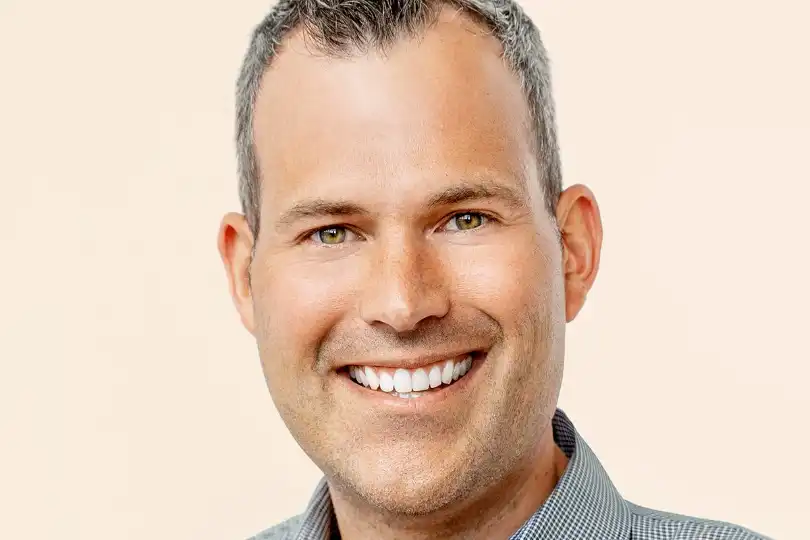
Meet Fidji Simo’s replacement as Instacart CEO: A former Apple director who helped drive iPhone market adoption
Instacarton Wednesday announced the replacement for CEO Fidji Simo, who helped bring the delivery company to a successful IPO in 2023. Simo will be succeeded by Chris Rogers, who previously served as a managing director for Apple Canada, where he helped bring iPhone adoption to market.Earlier this month, OpenAI announced it had hired Instacart CEO Fidji Simo to be its first CEO of Applications, a role Sam Altman carved out for her, overseeing product offerings and business operations. Although it was expected Simo would remain at the delivery company for “a few months” while the board found her successor, Instacart announced Wednesday it had already found her replacement: Chris Rogers.Recommended VideoSimo had joined Instacart in January 2019 as a board member and became CEO seven months later, replacing Apoorva Mehta. Simo helmed the company through its September 2023 IPO, having helped to raise $660 million to bring the company’s valuation to nearly $10 billion. Its market cap today is about $12.3 billion and its stock price is up nearly 10% since the start of 2025.Considering Instacart’s success, Simo’s departure came as a surprise to many—and she admitted as much in a memo to Instacart employees. Still, the OpenAI offer is one she couldn’t refuse.In the memo, she said she has “a passion for AI and in particular the potential it has to cure diseases” and that “the ability to lead such an important part of our collective future was a hard opportunity to pass up.” Simo had joined OpenAI’s board last year.“Fidji is exceptional,” Altman wrote in a May 8 X post. “We have worked together on OpenAI for the past year and I have observed her deep commitment to our mission. I cannot imagine a better new team member to help us scale the next 10x (or 100x, let’s see).”OpenAI wasn’t expecting to announce Simo’s appointment as soon as it did, blaming a media leak. At the time, the company said she would join OpenAI “later this year,” but it’s unclear whether she’ll join sooner now that Instacart has already named her replacement. OpenAI didn’t immediately answer aFortunequery about when Simo will join the company.Who is replacing Fidji Simo?On Wednesday, Instacart announced it had named Chris Rogers as CEO, effective Aug. 15, and Simo will remain chair of the board “to ensure a smooth transition,” according to the company. Rogers joined Instacart in 2019 and currently serves as chief business officer, overseeing commercial operations like retailer relationships and expansions, ad sales, research and development, partnerships, mergers and acquisitions, Instacart Business, and Instacart Health. He hasn’t always been in the grocery business, but has a 20-year career in consumer goods, technology, retail, and media. Rogers was most recently a managing director of Apple Canada, where he built and executed a country-specific strategy that drove iPhone adoption in the market. He had spent nearly 11 years at Apple, holding several roles like head of consumer retail and head of carrier channels for Canada.But Rogers actually started his career at consumer-goods giant Procter and Gamble, where he led relationships with Canada’s largest national grocery retailers. He was there until 2008. Rogers also sits on the board of consumer goods and retail analytics company Spins, and is a board member of the Ad Council. Rogers “brings the kind of vision, operational excellence, and customer obsession that will help Instacart play an even bigger role in people’s lives,” Simo said in a statement.Join us at the Fortune Workplace Innovation SummitMay 19–20, 2026, in Atlanta. The next era of workplace innovation is here—and the old playbook is being rewritten. At this exclusive, high-energy event, the world’s most innovative leaders will convene to explore how AI, humanity, and strategy converge to redefine, again, the future of work. Register now.
France seeks small parcel fees as flows from China surge
France is pushing to slap fees on small packages from discount retailers including China’s Temu and Shein Group Ltd. as the flood of cheap goods risks accelerating in response to the US’s sweeping tariffs.Recommended VideoThe proposed stopgap measure to put handling fees on such imports would come ahead of a wider European overhaul of customs duties due to come into effect in 2028, Budget Minister Amelie de Montchalin said during a visit to a parcel sorting center near Paris Charles de Gaulle airport on Tuesday.“Today is not 2028, so France is proposing fixed handling fees as soon as 2026,” she said. “It’s not a tax on consumers — it’s to make these platforms contribute more to checks we must do for security.”France’s effort to address a tide of cheap Chinese goods comes as President Donald Trump’s tariffs on small packages vastly increase the costs of merchandise from Shein and Temu for US consumers.Some policymakers in Europe are concerned that will divert yet more cheap clothing and goods into European countries, where there are currently no levies on parcels under €150 ($170.59).Competition ConcernsFrench Finance Minister Eric Lombard said authorities are worried about unfair competition against domestic companies and that many of the products do not respect safety norms.Even before Trump’s trade moves, the volume of small packages exported to France by digital platforms doubled year-on-year to 800 million in 2024, with around 90% from China.Days ago, UK Chancellor Rachel Reeves announced an examination of the country’s so-called de minimis rules, under which products valued at £135 ($180) or less can be imported without customs duty.The European Union has already proposed abolishing the exemption from duties for parcels under €150 and said it will reform the customs union to ensure trading platforms comply with the bloc’s regulations. Yet those changes are not due to come in until 2027 to 2028.France will seek to coordinate with other European countries on the handling fees to be applied before then. If other large importing countries don’t follow Paris on the issue, importers to the EU’s single market could circumnavigate any unilateral French action.Montchalin said she has already discussed the idea with the Dutch government and will talk with the new German administration in the coming weeks with a view to implementing the stopgap measure by 2026. The fee would be “a few euros,” but the exact amount would be coordinated with other member states.“Our ambition is to bring together all EU ministers in charge of customs so that in the coming weeks we can take measures that don’t destabilize our markets,” she said.Speaking alongside Montchalin, Lombard added that there is no direct link between the proposal and Trump’s tariffs, and said diverting trade flows is limited by air freight capacity.“Our aim is to protect French people whatever happens — it doesn’t depend on American decisions,” he said.Join us at the Fortune Workplace Innovation SummitMay 19–20, 2026, in Atlanta. The next era of workplace innovation is here—and the old playbook is being rewritten. At this exclusive, high-energy event, the world’s most innovative leaders will convene to explore how AI, humanity, and strategy converge to redefine, again, the future of work. Register now.
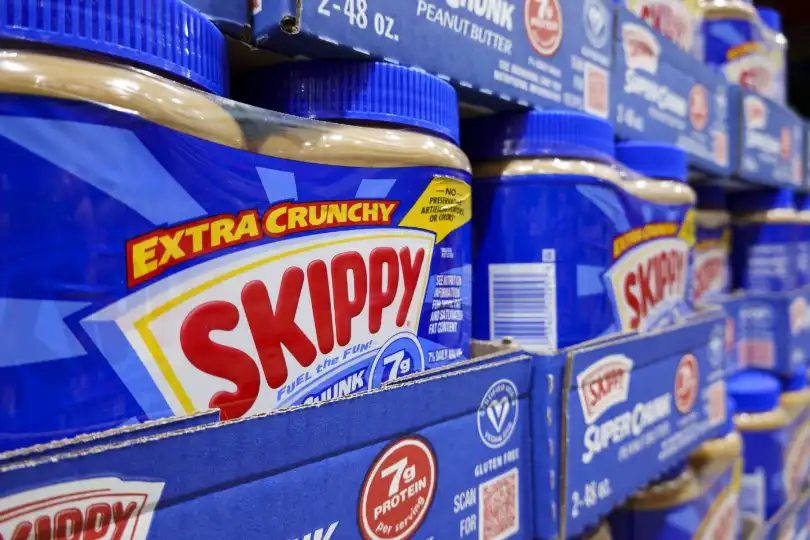
Hormel Foods says consumers are ‘strained’ as they trade down or hunt for value, but maintains outlook for the year
Hormel Foods maintained its full-year 2025net sales guidance at $12.2 billion despite economic uncertainty and tariff-related pressures, noting that consumers are feeling strained and adjusting their spending habits for maximum value. While tariffs have not significantly impacted Hormel yet, the company narrowed its growth and earnings forecasts slightly and emphasized strength in value-oriented and premium product lines like Applegate.In its second earnings call of the year, Hormel Foods held its guidance steady despite a shifting macroeconomic outlook.Recommended VideoHormel, known for kitchen staples such as Applegate, Skippy, and SPAM, narrowed its expectations during its earnings call Thursday but maintained its top-line expectation of $12.2 billion in net sales for the FY 2025.The extensive offerings and categories Hormel operates in enables the Austin, Minn.-based brand unique insight into the spending habits and sentiments of consumers.To this effect, executives noted shoppers are “strained” amid a “choppy environment.”Much of this uncertainty stems back to President Donald Trump’s tariff regime, which has upended everything from Wall Street’s outlook to inflation expectations. With consumers potentially bracing for higher prices as a result of the foreign policy, Hormel said some are trading down on their shops while others are focusing on maximum value.Consumers and analysts alike have whiplash from the news out of Washington D.C.: In the past few weeks alone, Trump’s team has reduced sky-high tariffs on China for 90-days, then accused Beijing of breaking the agreement, threatening 50% tariffs on the EU which were then delayed, and successfully appealed a court decision which banned the administration from introducing any of its “Liberation Day” measures.“I would describe the consumer sentiment as not great, meaning they’re feeling the cumulative effects of inflation and at the same time feeling uncertainty in the macro environment,” John Ghingo, executive vice president of Hormel’s retail division, told analysts on the call. “I would describe that as a strained consumer sentiment. And what’s interesting is you do see some trading down from consumers to lower prices.”He continued: “Some of our categories actually play very well for affordability, but if we pull back even from that and say, ‘where is the growth coming from?’ … we can see some very different pockets of strong growth because consumers are still looking for solutions.“They’re still looking for what they would classify… as value. And so within our own portfolio, we see strong growth still in the premium … with our Applegate brand.”Ghingo added that because consumers are stretched, they want to get maximum value and flexibility out of products—which is where protein products from Applegate and turkey specialists Jennie-O are flourishing.Tariffs and HormelOf course, businesses aren’t only impacted by tariffs because of the effect on customers, but also on their supply chain and relative costs.Most businesses say they are going to pass costs onto consumers, as the Federal Reserve noted in its May meeting: “Many participants remarked that reports from their business contacts or surveys indicated that firms generally were planning to either partially or fully pass on tariff-related cost increases to consumers.“Several participants noted that firms not directly subject to tariffs might take the opportunity to increase their prices if other prices rise.”Some brands, like Walmart, have already warned they may have to increase their prices—earning the ire of the Oval Office.Hormel, a Fortune 500 company, noted its portfolio has not been impacted by tariffs “to date” (though let’s not forget, the sharpest end of tariff threats are yet to come to fruition), with Jacinth Smiley, executive vice president and CFO at Hormel adding: “Although our business has not been materially impacted by the tariff landscape to date, based on what we know today, we have assumed a range of $0.01 to $0.02 of tariff impacts in the back half of the year in our outlook.”With that in mind, the brand narrowed its organic net sales growth outlook to a range of 2% to 3% and likewise narrowed its adjusted diluted net earnings per share expectations to $1.58 to $1.68.That being said, Smiley added: “We remain confident in our outlook for bottom-line growth for each segment in the second half of the year and remain committed to delivering long-term value through strategic execution.”Overall, Hormel reported Q2 2025 net sales of $2.9 billion with organic net sales up 1%.In the retail category, net sales were flat with volumes down 7% year-over-year, with segment profits climbing 4%. In the foodservice category, organic volumes were down 1%, and the segment profit was down 4%, though volumes increased 4%. In the international segment, volumes were up 9%, net sales up 7%, though segment profit fell 21%.Hormel’s share price is up 3.8% over the past five days, down approximately 3% for the year to date.Join us at the Fortune Workplace Innovation SummitMay 19–20, 2026, in Atlanta. The next era of workplace innovation is here—and the old playbook is being rewritten. At this exclusive, high-energy event, the world’s most innovative leaders will convene to explore how AI, humanity, and strategy converge to redefine, again, the future of work. Register now.
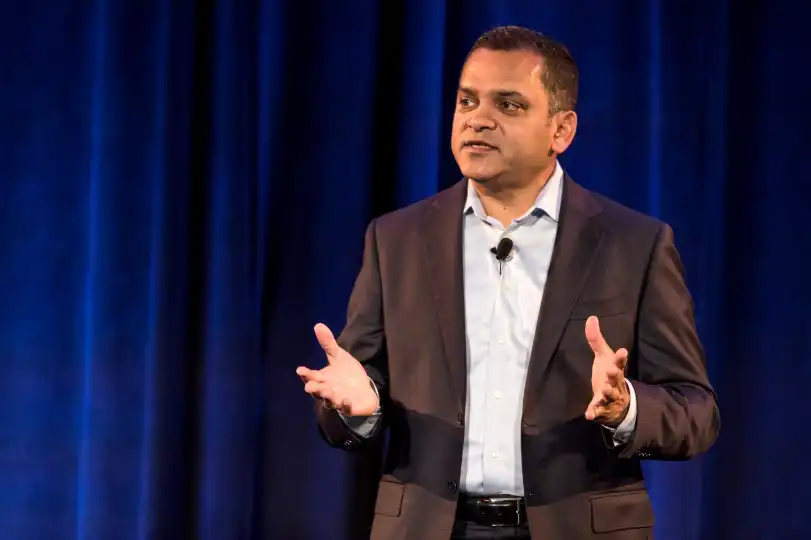
e.l.f. CEO says customers were ‘quite positive’ about the beauty giant raising prices due to tariffs: ‘We’re not trying to pull anything over on anyone’
Budget beauty giant e.l.f. recently announcedplans to increase the cost of its products by $1 due to tariffs. CEO Tarang Amin toldFortunecustomers have reacted positively to the announcement. “This is exactly what we’re facing, and they understand,” he said. Increased pricing is one of a few mitigation strategies the company is employing given tariff uncertainty.As companies brace for the impact of tariffs by passing down increased costs to consumers, not all businesses have drawn the ire of cautious shoppers.Recommended VideoAfter budget beauty giant e.l.f. announced it would raise prices due to the levies, its customers were grateful for the heads-up, according to CEO Tarang Amin.“The overwhelming response has been quite positive from our community. They appreciate [that] e.l.f. is always transparent,” Amin toldFortune. “We’re not trying to pull anything over on anyone. This is exactly what we’re facing, and they understand.”E.l.f announced this week plans to raise the prices of its products by $1, starting Aug. 1.“Bringing you the best of beauty is getting more $$$ but we’re committed to keeping the quality high and prices e.l.f.fordable,” the brand said in an Instagram caption about the price increase. “We are keeping an [eye] on the tariff situation as it evolves.”In the first months of President Donald Trump’s second term, consumer sentiment fell to its lowest levels since 2021 as a result of tariff uncertainty. In April, consumer confidence rebounded after Trump’s trade deal with China lowered the taxes from 145% to 30%. The future of tariffs continues to be shrouded in uncertainty. The U.S. Court of International Trade blocked Trump’s tariffs, ruling on Wednesday the White House did not have the authority to impose the sweeping economic sanctions.“Today’s news emphasizes the uncertainty and noise around tariffs,” Amin toldFortunein a statement. “What would be helpful to us and other companies is long-term resolution so we can focus on long-term strategy….We will continue to be transparent with our community and bring them on the journey as they are incredibly important voices in our business conversations.”The company did not provide fiscal 2026 guidance in its fourth-quarter and full fiscal 2024 earnings on Wednesday due to tariff unpredictability. E.l.f. posted $332.6 million in quarterly net sales, a 4% year-over-year increase, as well as a 28% boost in year-over-year annual net sales to $1.3 billion.How e.l.f. is managing tariffsThe price increase is one of a handful of mitigation techniques e.l.f. is implementing to offset the impact of tariffs. Since 2019, following Trump’s tariffs on China during his first term, e.l.f. began shifting some of its supply chain away from China, where it once had about 100% of its production. Today, e.l.f. has about 75% of its supply chain in China, according to Amin, but the company is not planning to completely divest from operations there.“We’re also not like some companies that say they’re 100% getting out of China,” Amin said. “We’re committed to our team and our suppliers there, and we want to continue long term partnerships that we’ve developed over the years that give us the advantage that we see.”Instead, e.l.f. has diversified production across China, Europe, Thailand, and the U.S., Amin said, with the intention to continue to expand U.S. production. Hailey Bieber’s beauty brand Rhode, which e.l.f. just acquired in a $1 billion deal, has most of its production in South Korea and Italy.The company is also relying more heavily on its international demand, the fastest-growing part of the business, according to Amin.“You’re going to see a globally distributed core supply chain for us, the main objective of which is to meet the global consumer demand we see for our brands,” he said.E.l.f. will employ its communication style regarding tariff ramifications internally as well. The company gives its 600 workers equity when they are hired, as well as new grants every year, meaning stock-market jitters as a result of tariff concerns has direct stakes for e.l.f employees, chief people officer Scott Milsten toldFortunelast month.“We sort of overshare internally,” Milsten said. “So while this is a time when I think you might find companies sort of retreating into silence, we absolutely go the other way.”Join us at the Fortune Workplace Innovation SummitMay 19–20, 2026, in Atlanta. The next era of workplace innovation is here—and the old playbook is being rewritten. At this exclusive, high-energy event, the world’s most innovative leaders will convene to explore how AI, humanity, and strategy converge to redefine, again, the future of work. Register now.
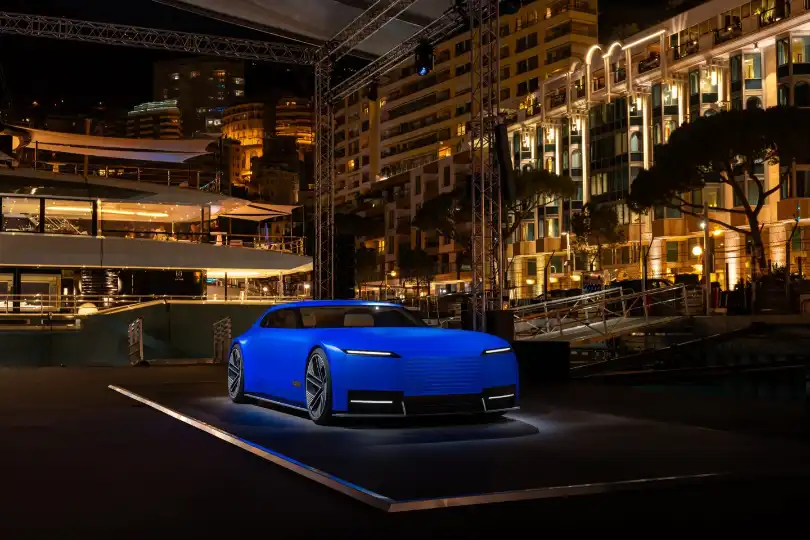
Jaguar is going on a world tour to sell its controversial rebrand to wealthy art lovers
It’s been around six months since Jaguar, the 89-year-old British premium car brand, decided to arguably torpedo its legacy in search of a new, younger audience. Depending on who you asked, it was either the boldest or stupidest brand decision in years.Recommended VideoLast November, Jaguar’s debut of an advert showing a diverse, gender-fluid set of fashion models but crucially, no car, inspired a wave of vitriol days after the election of Donald Trump to the White House. The DEI-inspired message didn’t as much fail to land as it did outright clash with an “anti-woke” narrative online, which had reached fever pitch around the time of Trump’s election.It was, however, a statement of intent for a brand that had grown old with its customers and was staring down a black hole of irrelevance among future generations.Jaguar.Under the bonnetJaguar’s least forgiving critics might have argued the carless rebrand launch signaled last-minute planning. In reality, the launch was the culmination of a four-year design process. In November 2020, Jaguar tasked its 800-strong design team with developing a winning concept for its ambitious rebrand. The instructions centered around Jaguar’s eventual motto for the new concept car: “Copy nothing,” and focus on building a six-figure car that will catapult the brand out of the premium market and into the luxury one.The carmaker split its designers into three teams, launching an internal competition between November 2020 and March 2021. Vít Rosický, a creative specialist at Jaguar, helped lead the winning team and focused on the interior of the car. Sporting a cardigan and thick, circular, black glasses, Rosický perhaps isn’t the archetypal car designer. A student of the Academy of Fine Arts and Design, Bratislava, and a fan of the pioneering modernist architect Ludwig Mies van der Rohe, he talks fondly about Jaguar’s commitment to “reductive design” in its cars and speaks affectionately about the unusual materials present in the Type 00 Concept Car.Rosický’s musings help explain the car’s design, an unusually long, imposing two-door vehicle in bold “Miami Pink” and “Ultramarine Blue,” a steep departure from its old models. The interior too, is more like the inside of an LA pad than of a car.“We don’t want to do automotive interior, but rather a beautiful, compelling space with unexpected materials.” Travertine stone and brass are just two of those “unexpected materials” inside the concept car.“I actually wasn’t nervous,” Rosický toldFortuneabout the car’s launch, dismissing any fears of a backlash in the build-up to the unveiling. “Because the biggest shift in emotions came from releasing the advert. And I already knew that we have an awesome car that backs the statement that we made.“Maybe the only nervousness came from a point where I really wanted to show it straight away,” he conceded. “And that’s kind of what I’m feeling now towards the production car. Because just wait till you see that.”It’s important to note that the Type 00 that debuted at Miami Fashion Week last year is not the same car that will roll off the production lot ready to drive in 2026. For one, the car will have four doors and will cost upwards of $100,000, but the manufacturer is keeping quiet about other changes. Jaguar.Jaguar’s rebrandNo matter Jaguar’s optimism ahead of the Type 00’s production release next year, the wave of negative media attention must have stung. But with only a concept car so far to show for its efforts, it’s far too early to tell which side of the rebrand argument will be right.As of May, the group’s launch video has 171 million views on X, and thousands of replies, the most prominent of which are mocking the carmaker. Some, including X owner and EV competitor Musk, even questioned whether “carmaker” was an appropriate description for the company.“Do you sell cars?” Musk asked Jaguar.Nigel Farage, leader of the right-wing populist Reform UK party, declared: “I predict Jaguar will now go bust. And you know what? They deserve to.”Jaguar CEO Rawdon Glover was forced to lament what he described as “vile hatred and intolerance” regarding the rebrand. In a biting rebuttal, Glover said Jaguar’s aspiring new audience didn’t match Farage’s demographic. The fact that all this discourse was fomented without any car to show has been a deeper source of criticism for moderates. Glover, however, suggested at the time that this was the point.“More people have been talking about Jaguar for the last two weeks than—goodness, for so much longer. Car companies unveil new cars all the time and go completely unnoticed,” Glover told Sky News in December.Nick White, Jaguar Land Rover’s director for global marketing and online, hasn’t diverged from that company line when he speaks withFortunesix months later. “There’s a great Oscar Wilde quote, that the only thing that is worse than being talked about, is not being talked about,” said White. “So, my view is that we became the most talked-about brand in the world. I mean, that’s a fantastic place to be when you’re doing change.”Jaguar has been taking its concept car on a global tour, pit-stopping at each of the Formula E locations, where, alongside its partner TCS, the carmaker has been competing on the race track. The tour has offered a chance to expose the car to an electric-friendly audience, woo prospective wealthy customers, and do market research ahead of the production car’s launch.During its earnings call in early May, JLR said 32,000 people had “expressed interest” in the Jaguar’s new GT model. The carmaker expects about 20% of its current customers to come with the carmaker on the journey, the rest moving aside owing to price, age, and inevitably, taste. White, however, has a clear idea of the new demographic Jaguar is targeting to fill the gap.“We had a transition from traditional car people to people who like luxury and fashion, and that’s exactly what we’re trying to do,” White said of the digital data it reviewed during the Miami Fashion Week launch. We’ve been competing in the mass market for the last 20 years. We’re never going to win that game.”Join us at the Fortune Workplace Innovation SummitMay 19–20, 2026, in Atlanta. The next era of workplace innovation is here—and the old playbook is being rewritten. At this exclusive, high-energy event, the world’s most innovative leaders will convene to explore how AI, humanity, and strategy converge to redefine, again, the future of work. Register now.

Forget SUVs: Minivans are having a renaissance—and they’ve never been this plush
One of the biggest car launches at Auto Shanghai 2025 in China from a European brand was the Mercedes-Benz Vision V. Surprisingly, this isn’t an SUV nor a luxury super-sedan. It’s a minivan (aka MPV). This wasn’t the only MPV displayed at the show either. Just when everyone thought SUVs had a permanent stranglehold on the market are minivans making an unexpected comeback?Fall and rise of the MPVMPVs used to be familiar sights on European roads. Never considered aesthetically desirable, the practicality of having up to seven seats and plenty of cargo space nevertheless made them popular family choices compared to estate cars (aka station wagons). At their height, MPVs had as much as 10% of the European market. But sales began to fall significantly by the end of the Noughties, with SUVs, some offering a more stylish seven-seat option, taking over. By 2023, MPVs had fallen to just 2% of the European market.The new generation of minivans is different from these family transporters, however, and that’s exemplified by the Vision V from Mercedes-Benz. This is no utilitarian people carrier. It’s a luxury limousine intended to be chauffeur-driven, aimed at a similar market to the seminal S-Class, and even the Maybach variant of that model. The design of the Vision V is futuristic, and the interior is intended to make Rolls-Royce owners jealous. Rear seat passengers can enjoy a 65-in screen, which dwarfs even the one in BMW’s ultrahigh luxury i7 sedan limousine, plus 42-speaker Dolby Atmos sound. The experience is more about lounging than lugging many passengers around. Mercedes-Benz is aiming to bring the first models based on the Vision V concept to market in 2026.James MorrisLuxury vans have become a bit of a thing in China. The poster child of this trend is the Zeekr 009. Although there are conventional versions of this van with the usual six or seven seats, the headline act is an interior option for just two occupants in the back, like the Vision V, called the Grand. These two seats are combined with a giant 43in screen. The seats in the 009 Grand are veritably palatial, with every comfort imaginable on tap, including a refrigerator. The effect is to take a conventional luxury transport experience to a new level, and it’s going down well with consumers. The 009 sold 19,210 units in 2023 and 22,631 units in 2024 in China, although there was no information available about what proportion of this was the two-rear-seater Grand version.Zeekr also launched an innovative take on the MPV at the Chinese car show in 2024 (which took place in Beijing – the show alternates between this city and Shanghai biannually). The Mix is a more mainstream minivan than the 009, aimed at families wanting an MPV that enhances their lifestyle. This vehicle’s main party trick is its lack of a B-pillar (facilitating passenger ingress) and novel seat permutations. The two front seats can rotate to face rearwards and then a table can be installed in the middle, turning the Mix into a mobile dining room – great for family picnics in the country. The Mix hasn’t been selling as well as the 009, but it’s indicative of the new creative direction MPVs are taking in China. It also happens to be built on a platform Zeekr has been developing in partnership with Waymo, the autonomous taxi company. So you can see where the Mix might be headed.Signaling the importance of the minivan market in China, Volvo had its EM90 minivan on show at Auto Shanghai 2025 as well. This car has also become one of the lead vehicles displayed in Volvo’s Chinese shopping mall showrooms. The EM90 is, unsurprisingly, built on the same platform as the Zeekr 009 (both automakers are part of Chinese giant Geely). So far, however, it hasn’t met with the same success as the Zeekr alternative.James MorrisToyota clearly sees potential in the MPV resurgence in Asia and launched the Veloz in 2021, aimed at Southeast Asian markets including Thailand and Malaysia, as well as Arabian Gulf states. In these regions, the minivan never really went away, however. The Veloz is an upmarket take on the MPV that its subsidiary Daihatsu has been selling as the Xenia and Toyota as the Avanza since 2003. The difference with the Veloz is its greater focus on luxury, although this is not anywhere near the same level as the Zeekr 009. Toyota also offers the Alphard MPV in similar regions to the Veloz, as well as Japan, alongside its more premium Lexus LM variant.Minivans are back, but this time, they’re palacesSo, the MPV is enjoying a luxury renaissance in Asia. The question is whether this trend will translate into Europe and the U.S. as well. Volkswagen has long been a minivan favorite in both regions, going all the way back to the “Splitscreen” in 1950. Most recently, the ID. Buzz has taken the company into an electrified MPV future, although a U.S. recall has dampened the launch and the high price has kept sales numbers low in Europe despite generally positive reviews. The ID. Buzz sold less than 30,000 units globally in 2024. However, while the third row of seats in most SUVs are only viable for children if you travel any further than a quick urban journey, the third row in a Long Wheelbase ID. Buzz is completely adult-friendly, a feature that is unique in EVs available in Europe so far. It’s a vehicle lots of people want, even if not so many are actually buying it yet.Some brands are betting on the MPV picking up again outside Asia, though. Chinese challenger brand XPENG is hoping that a rebirth of the minivan will give it an edge in the European market. Although the company’s first cars in the EU were a sedan and a large SUV, and a smaller SUV called the G6 for its debut in the U.K., the next vehicle on the roadmap for release is the X9. This is another luxury MPV in the mold of the Zeekr 009, although not pitched quite so high. It was unveiled at the U.K. launch of the G6, and is due to go on sale in the second half of 2025. Mercedes-Benz is also planning to launch the Vision V in the U.S. and Europe as the VLS, alongside a premium family minivan called the VLE based on the same VAN.E electric platform.The jury is still out on whether the luxury turn of minivans that has proven popular in China will be replicated in other markets. SUVs still had a 54% market share in Europe in 2024, 3% more than the previous year. It’s also unlikely that MPVs will regain the mainstream popularity they once had in the mainstream European market. But this new luxury trend is something different and not aimed at the same volume of sales as before. You may be seeing more of these palaces on wheels even in Europe soon. You certainly will see plenty of them if you visit China.Join us at the Fortune Workplace Innovation SummitMay 19–20, 2026, in Atlanta. The next era of workplace innovation is here—and the old playbook is being rewritten. At this exclusive, high-energy event, the world’s most innovative leaders will convene to explore how AI, humanity, and strategy converge to redefine, again, the future of work. Register now.